Introduction
Age is one of the most important factors life insurers consider when pricing a new policy.
In general, buying life insurance at a younger age can mean lower premiums because the insurer expects to cover a lower mortality risk over the policy period.
But there is no reliable rule stating that life insurance becomes a certain percentage more expensive every year.
Your actual premium depends on much more than your age.
Insurers can also consider factors such as:
- Health
- Tobacco and nicotine use
- Coverage amount
- Policy type
- Term length
- Underwriting class
- Medical history
- Family history
- Occupation and lifestyle
- State
- Individual insurer guidelines
Quick answer: Life insurance generally becomes more expensive to purchase as you get older, but there is no universal annual percentage increase. Age can also affect which policy types and term lengths remain available. If you already know that you need coverage, delaying solely in hopes of getting a better price later generally works against the age component of underwriting.
How Age Affects Life Insurance
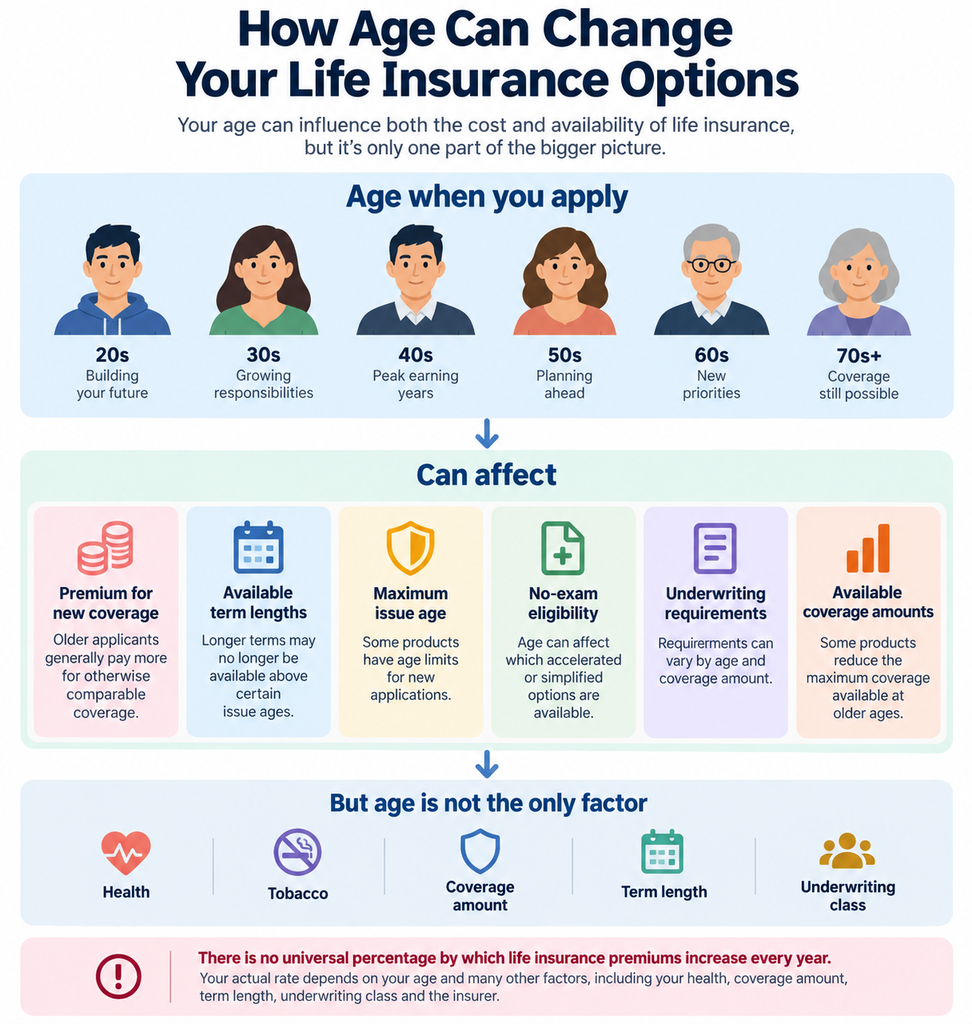
Age can influence life insurance in several different ways.
| Age-Related Factor | Potential Effect |
|---|---|
| Premium | Older applicants generally pay more for otherwise comparable new coverage |
| Available term lengths | Longer terms may no longer be available above certain issue ages |
| Underwriting requirements | Requirements can vary by age and coverage amount |
| No-exam eligibility | Some accelerated or simplified pathways use age limits |
| Maximum coverage | Some products reduce available amounts at older ages |
| Product availability | Certain products stop accepting new applicants after a specified age |
| Renewal cost | Renewing term coverage after the level period can become significantly more expensive |
Age therefore affects more than the monthly price.
It can change the set of policies you are able to buy.
Why Life Insurance Generally Costs More as You Age
Life insurance pricing is based partly on the probability that the insurer will need to pay a death claim.
As an applicant gets older, mortality risk generally increases.
For a new level-term policy, the insurer must price coverage based on the applicant’s age and risk profile when the policy is issued while guaranteeing the applicable premium for the selected level period.
That is why two otherwise similar applicants applying for the same policy at different ages may receive different premiums.
The older applicant is asking the insurer to cover a later period of life.
However, age is only one factor.
A younger applicant with significant health problems or tobacco use can receive a worse offer than an older applicant with a stronger underwriting profile.
There Is No Universal Annual Percentage Increase
You may see claims online such as:
Life insurance becomes a specific percentage more expensive every year you wait.
That is too simplistic.
There is no universal annual increase that applies across:
- Every age
- Every insurer
- Every term length
- Every death benefit
- Every underwriting class
- Every applicant
The difference between buying at age 30 and age 31 may not resemble the difference between applying at age 59 and age 60.
Pricing can also change because an insurer updates its rates or because the applicant enters a different age band, loses eligibility for a product or receives a different underwriting classification.
The useful principle is much simpler:
When comparing otherwise similar new policies, increasing age generally works against the applicant on price.
Use actual quotes rather than applying a fixed percentage.
Age Can Affect Which Term Lengths You Can Buy
One of the most overlooked effects of age is product eligibility.
A longer term commits the insurer to providing coverage for more years.
As a result, insurers commonly impose lower maximum issue ages on their longest terms.
State Farm’s current Select Term product provides a clear example:
| Term Length | Current State Farm Issue Ages |
|---|---|
| 10 years | 18–75 |
| 20 years | 18–65 |
| 30 years | 18–45 |
Someone age 40 can potentially consider all three durations.
Someone age 60 cannot apply for a new State Farm 30-year Select Term policy under the current rules.
That does not mean a 60-year-old cannot buy long-duration life insurance anywhere.
Different insurers have different age limits.
It illustrates why waiting can affect availability as well as price.
Our guide to 10-Year vs. 20-Year vs. 30-Year Term Life Insurance explains how to match the policy duration to your actual financial need.
Different Insurers Use Different Age Rules
Your birthday does not always translate into the same insurance age at every company.
Guardian notes that an insurer may use either an applicant’s actual age or an age based on the nearest birthday, depending on the provider.
Banner Life, for example, currently defines age for its OPTerm underwriting and issue-age rules as:
age nearest birthday.
This means someone approaching a birthday can potentially be treated as one year older for that insurer’s pricing or eligibility purposes before the actual birthday arrives.
Other insurers can use age-last-birthday or different contractual definitions.
Do not assume that every insurer calculates insurance age the same way.
When a birthday is approaching, ask the insurer or agent:
- What insurance age will be used?
- Does the birthday change my premium?
- Does it affect the maximum term available?
- Does it affect accelerated-underwriting eligibility?
The answer should come from the actual insurer rather than a generic online rule.
Buying Younger Can Lock In a Level-Term Premium
One advantage of level-term insurance is that the premium is generally guaranteed for the initial selected term when the policy is maintained according to its contract.
For example, someone who purchases a 20-year level-term policy does not normally receive a new premium every birthday during those 20 years simply because they became older.
Their age was considered when the policy was issued.
The premium structure then follows the contract.
This distinction is important:
Age affects the price when you buy the policy.
It does not necessarily mean your premium increases every year after purchase.
The NAIC describes level term as coverage in which the death benefit and premium remain fixed throughout the specified level period, commonly 10, 20 or 30 years.
What Happens When the Level Term Ends?
Age becomes important again when the initial level period ends.
Depending on the contract, you may be able to:
- Let the policy expire
- Renew coverage
- Convert eligible coverage
- Apply for a new policy
If you apply for a new policy, the insurer evaluates you at your new age and based on your current underwriting profile.
If you renew the existing term policy without new underwriting, the renewal premium can still become substantially higher.
State Farm explicitly notes that its Select Term policies can continue on an annually renewable basis to age 95 after the initial level term, but premiums increase with subsequent renewals.
This is why a short term should not be selected solely because it has the lowest initial quote.
Age and Health Work Together
Your age does not operate independently from health.
Consider two hypothetical applicants.
Applicant A
- Age 35
- Smokes cigarettes
- Has multiple uncontrolled health conditions
Applicant B
- Age 42
- Does not use tobacco
- Has a stronger overall health profile
It would be incorrect to assume Applicant A must receive the better rate simply because they are younger.
Underwriting considers the full risk profile.
Age matters, but it does not erase the effects of:
- Tobacco use
- Blood pressure
- Cholesterol
- Diabetes
- Cardiovascular history
- Cancer history
- Medications
- Build
- Driving history
- Other medical and lifestyle factors
That is why online age-only quote charts should be treated as illustrations rather than promises.
Age and Tobacco Use
Age and tobacco status can interact to produce very different quotes.
A younger smoker may pay substantially more than a similar nonsmoker.
Insurers also differ in how they classify:
- Cigarettes
- Cigars
- Vaping
- Nicotine replacement products
- Nicotine pouches
- Former tobacco use
There is no single tobacco rule across the market.
Our guide to life insurance for smokers explains why carrier-specific underwriting matters.
Age and Diabetes or Other Health Conditions
Older applicants are also more likely to have accumulated medical history that underwriting needs to evaluate.
But a diagnosis does not automatically determine the rate.
For example, life insurers evaluating diabetes can consider:
- Type of diabetes
- Age at diagnosis
- A1C history
- Treatment
- Control
- Complications
- Medical follow-up
- Other cardiovascular risk factors
There is no valid universal formula such as:
Age + A1C = underwriting class.
Our guide to life insurance for diabetics explains this in more detail.
Age Can Affect No-Medical-Exam Options
No-exam life insurance is not one single category.
It can include:
- Accelerated underwriting
- Simplified issue
- Guaranteed acceptance
These pathways often have their own age and coverage limits.
For example, an accelerated-underwriting program that can provide substantial coverage to an applicant in their 30s or 40s may have lower maximum amounts, additional requirements or no eligibility at much older ages.
That does not mean older applicants cannot obtain coverage without a medical exam.
It means the available products can change.
Someone over 70, for example, may increasingly encounter simplified or guaranteed-acceptance permanent products rather than large accelerated-underwriting term policies.
See our Best No-Medical-Exam Life Insurance in 2026 guide for the underwriting categories, and our Best No-Exam Life Insurance Over 70 guide for older-applicant options.
Your 20s and 30s
Life insurance can be relatively inexpensive during these decades for applicants who qualify for favorable underwriting.
But being young does not automatically mean you need life insurance.
The key question is whether your death would create a financial problem for someone else.
Possible reasons for coverage include:
- Children
- A financially dependent partner
- A mortgage
- Shared debts
- Business obligations
- Other dependents
If nobody depends financially on you and there is no significant financial obligation to protect, buying a large policy solely because you are young may not be necessary.
Age should influence the cost decision, not create a need that does not exist.
Your 40s
Many people in their 40s still have substantial insurance needs.
These can include:
- Income replacement
- Children
- Mortgage payments
- College funding
- Support for a spouse
- Business obligations
Term coverage can still be widely available, but some of the longest durations may begin approaching their maximum issue-age limits depending on the insurer.
This is also a point where delaying several more years can meaningfully change both underwriting and product availability.
Your 50s
Buying life insurance in your 50s is still possible, but policy selection becomes increasingly important.
A person in their 50s may have:
- Fewer years of income to replace
- Older children
- A smaller mortgage
- More retirement assets
That can reduce the amount or duration of coverage needed.
At the same time:
- New coverage generally costs more than it would have at a younger age.
- Some long term lengths may no longer be available.
- Health history may play a larger role.
- Conversion rights on existing coverage can become important.
Do not automatically replace an expiring policy with the same death benefit and term.
Recalculate the actual financial gap first.
Your 60s
Life insurance needs often shift again in the 60s.
Instead of protecting decades of employment income, the objective may involve:
- Supporting a surviving spouse
- Covering a remaining mortgage
- Estate liquidity
- Final expenses
- Business obligations
- Legacy goals
Traditional term coverage can still be available, but maximum durations become more limited at many insurers.
The correct question is usually not:
“Can I still buy life insurance?”
It is:
“What financial problem am I trying to solve, and which policy structure addresses it efficiently?”
Your 70s and Beyond
Life insurance remains available at older ages, but the market narrows.
Some applicants may still qualify for traditionally underwritten coverage.
Others may compare:
- Shorter-duration term
- Permanent insurance
- Simplified-issue coverage
- Final-expense insurance
- Guaranteed-acceptance coverage
Coverage amounts can become smaller and premiums higher.
Guaranteed-issue products can also include graded or limited death benefits during the first policy years.
Age therefore makes it especially important to distinguish between:
what is available
and:
what actually solves the financial need.
Should You Buy Life Insurance Before Your Birthday?
If you already need coverage and a birthday is approaching, it can be reasonable to obtain quotes now rather than automatically waiting.
But there is no universal “buy X days before your birthday” rule.
The effect depends on how the insurer calculates insurance age.
Some use age nearest birthday.
Others can use age last birthday or another contractual definition.
Your birthday may also affect:
- Term eligibility
- Coverage limits
- Underwriting pathways
- Product availability
Ask the insurer which age will apply to the proposed policy.
Do not manipulate application dates or assume that a policy can simply be backdated to obtain a younger age. Policy-date and backdating rules are insurer- and state-specific.
Should You Wait Until Your Health Improves?
This can be a more complicated decision.
Suppose someone recently:
- Quit smoking
- Lost substantial weight
- Improved diabetes control
- Completed treatment for a medical condition
- Recovered from surgery
Waiting could potentially affect underwriting.
But waiting also means becoming older.
There is therefore a trade-off between:
potential health improvement
and:
additional age.
There is no universal answer.
If a health change could materially alter underwriting, compare the insurer-specific requirements rather than guessing how many months you should wait.
Buying Now vs. Waiting Worksheet
Before delaying an application, write down:
Current age: ______
Next birthday: ______
Coverage needed: $________
Required term: ______ years
Current estimated quote: $________ / month
Insurance age used by insurer: ______
Will the next birthday change eligibility? Yes / No / Unknown
Will the next birthday remove a term option? Yes / No / Unknown
Current health issue affecting underwriting: ______
Expected health improvement: ______
Evidence that waiting could change underwriting: ______
How long would I wait? ______
Would my family be uninsured during that period? Yes / No
Then ask:
- Do I actually need the coverage today?
- Am I delaying because of a documented underwriting reason or merely hoping prices improve?
- Does the insurer calculate age nearest birthday or last birthday?
- Will waiting affect the term length available?
- Could my health deteriorate instead of improve?
- Is an acceptable policy available today?
This does not decide whether you should apply immediately.
It helps identify the actual trade-off.
Do You Need the Same Amount of Coverage as You Get Older?
Not necessarily.
Insurance need can decline as:
- Mortgage balances fall
- Children become financially independent
- Savings increase
- Retirement accounts grow
- Debts are repaid
For example, someone who needed $1 million of income-replacement protection at age 35 may not still need the same amount at age 60.
But that should be calculated rather than assumed.
A surviving spouse may still depend heavily on income, pension benefits, housing or shared retirement assets.
Before buying or replacing coverage, calculate how much life insurance you actually need based on the current financial gap.
Age Should Not Be the Only Reason to Buy
Buying younger can reduce the age component of life insurance pricing.
That does not mean everyone should purchase coverage as early as possible regardless of need.
Life insurance exists to transfer a financial risk.
The decision should start with questions such as:
- Who would be financially affected if I died?
- How much money would they need?
- How long would that need exist?
- What resources already exist?
Only then should age influence when and how the coverage is purchased.
Common Mistakes to Avoid
Believing premiums increase by a fixed percentage every year. There is no universal annual rate increase.
Assuming your premium automatically rises every birthday after buying level term. The initial level premium is generally fixed for the contractual level period.
Waiting without checking the insurer’s insurance-age method. Some insurers use age nearest birthday.
Ignoring maximum issue ages. Waiting can remove certain term lengths or products from consideration.
Choosing a short term solely because it is cheaper today. You may need to reapply later at an older age and potentially with different health.
Assuming younger always means a better underwriting class. Health, tobacco use and other risk factors still matter.
Keeping the same coverage amount forever without recalculating the need. Financial obligations change over time.
Assuming no-exam coverage remains equally available at every age. Underwriting pathways and maximum amounts can change as applicants get older.
Frequently Asked Questions
Does life insurance get more expensive as you get older? Generally, yes, when comparing otherwise similar new policies. Age is an important pricing factor because mortality risk generally increases with age. The exact difference depends on the insurer, policy and applicant.
How much does life insurance increase each year with age? There is no universal annual percentage. The change depends on age, insurer, term length, death benefit, underwriting class and product rules.
Do life insurance premiums increase every birthday? Not necessarily. With level-term insurance, the premium is generally fixed during the initial level period. Age affects the premium when the policy is issued. Premiums can change after the level period according to the contract.
Is life insurance cheaper in your 20s than your 30s? For otherwise comparable healthy applicants and coverage, younger age generally favors lower pricing. But whether someone in their 20s actually needs insurance depends on their financial obligations and dependents.
Is 40 too old to buy term life insurance? No. Many term products remain available at age 40, including long-duration options from some insurers. Eligibility depends on the company, term and underwriting.
Is 50 too old to buy life insurance? No. Life insurance remains widely available in the 50s, although premiums are generally higher than for younger applicants and some longer terms may have lower maximum issue ages.
Can someone in their 60s get term life insurance? Yes. Term insurance remains available from multiple insurers, but available durations and coverage amounts depend on the company and applicant.
Can someone over 70 get life insurance? Yes. Options can include traditionally underwritten, simplified-issue and guaranteed-acceptance products. Available term lengths and death benefits become more limited as age increases.
Should I buy life insurance before my birthday? If you already need coverage, it can make sense to obtain quotes before the birthday. However, insurers use different insurance-age methods, so ask how the specific carrier calculates your issue age.
Does turning 50 or 60 automatically cause a huge price increase? Not universally. Pricing does not follow one standard age-band formula across every insurer. Obtain matched quotes rather than assuming a particular birthday produces a fixed increase.
Can waiting improve my life insurance rate? Sometimes a meaningful health improvement could improve underwriting, but waiting also increases age and creates the risk of another health change. The decision should be based on insurer-specific underwriting criteria.
What matters more, age or health? Both matter, along with several other factors. There is no universal formula that determines which will have the larger effect for every applicant.