


Introduction
Having type 1 or type 2 diabetes does not automatically prevent you from qualifying for life insurance.
But diabetes can affect underwriting.
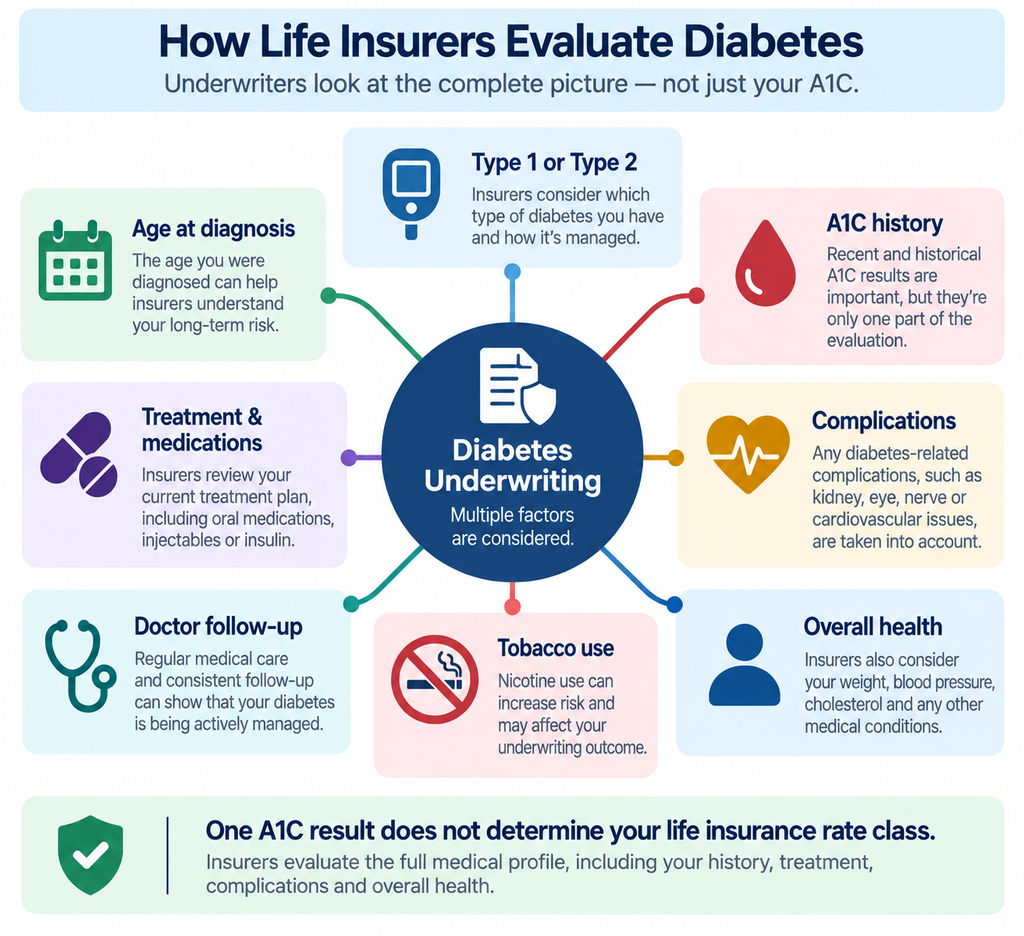
Insurers may look at how long you have had the condition, how it is treated, your recent and historical A1C results, whether complications are present and your overall health.
That means two people with the same type of diabetes — or even the same recent A1C — can receive very different insurance offers.
Quick answer: John Hancock deserves particular attention because its Aspire program is specifically designed for eligible people living with type 1 or type 2 diabetes. Protective and Transamerica are also worth comparing for traditionally underwritten term coverage because both publicly document how diabetes is evaluated rather than treating the diagnosis as an automatic decline. For older applicants who cannot qualify for medically underwritten coverage and need only a small permanent death benefit, guaranteed-acceptance coverage such as Mutual of Omaha’s Guaranteed Whole Life can provide another option.
There is no universal “best company for diabetics,” and we do not assign rate classes based on A1C alone.
How Diabetes Affects Life Insurance Underwriting
Life insurance underwriting estimates the risk associated with insuring an applicant.
A diabetes diagnosis is one part of that assessment.
An insurer may evaluate:
- Type 1 or type 2 diabetes
- Age at diagnosis
- Current age
- Recent A1C results
- A1C history over time
- Insulin use
- Other medications
- Frequency of medical follow-up
- Blood-pressure control
- Cholesterol
- Height and weight
- Tobacco or nicotine use
- Kidney function
- Cardiovascular history
- Neuropathy
- Retinopathy
- Circulatory problems
- History of hospitalization
- Other medical conditions
The complete picture matters more than a single number.
John Hancock, for example, currently states that its underwriters consider A1C history, age at diagnosis, treatment, medication and diabetes-related complications when assessing an applicant.
Protective similarly explains that diabetes underwriting considers how serious the condition is and how well it is being managed.
A1C Matters — But It Is Not a Life Insurance Rate-Class Chart
A1C is an important medical measurement because it reflects average blood glucose over approximately the previous several months.
Type 1 vs. Type 2 Diabetes
Insurers can evaluate type 1 and type 2 diabetes differently, but neither diagnosis automatically means coverage is impossible.
Type 1 diabetes
Type 1 diabetes generally involves lifelong insulin treatment and is often diagnosed at a younger age.
Underwriting may place particular importance on:
- Age at diagnosis
- Duration of the condition
- Glucose-control history
- A1C trend
- Frequency of hypoglycemic events
- Kidney function
- Eye health
- Cardiovascular health
- Neuropathy or other complications
A person who has lived with type 1 diabetes for many years without significant complications can present a different risk profile from someone with unstable control or significant complications.
Type 2 diabetes
Type 2 diabetes also varies substantially between applicants.
Treatment may involve:
- Diet and lifestyle management
- Oral medication
- Injectable medications
- Insulin
- A combination of approaches
An insurer may consider both the treatment required and how successfully the condition appears to be managed.
The fact that someone uses insulin does not, by itself, tell you whether they will be approved or what their rate will be.
Best Life Insurance Options for Diabetics at a Glance
| Company | Option Worth Investigating | Why It Stands Out | Important Limitation |
|---|---|---|---|
| John Hancock | Aspire with eligible term or permanent policies | Program specifically designed for people with type 1 or type 2 diabetes | Underwriting still applies; savings are not guaranteed |
| Protective | Classic Choice Term | Broad term range and publicly documented diabetes underwriting considerations | Not a diabetes-specific product; medical underwriting may be required |
| Transamerica | Trendsetter Super | Broad term and coverage options; official underwriting materials specifically gather diabetes history | Outcome depends on full underwriting; no universal diabetes rate class |
| Mutual of Omaha | Guaranteed Whole Life | No health questions or medical exam for eligible ages | Only $2,000–$25,000; designed for small permanent needs |
These are different types of insurance.
A $20,000 guaranteed whole-life policy should not be compared as though it solves the same problem as a $500,000 term policy.
John Hancock Aspire — The Most Diabetes-Specific Option
John Hancock is unusual because it currently operates a life insurance program explicitly designed for people living with type 1 or type 2 diabetes.
The program is called John Hancock Aspire.
Aspire can be used with eligible John Hancock:
- Term life insurance
- Permanent life insurance
John Hancock’s current term offering provides:
- 10-year terms
- 15-year terms
- 20-year terms
- 30-year terms in eligible jurisdictions
- Coverage currently listed from $250,000 to $30 million
Actual availability depends on underwriting and state rules.
What makes Aspire different
Aspire is integrated with the John Hancock Vitality program.
Eligible policyholders can receive benefits for health-related activities, including diabetes-management activities.
With Vitality PLUS, John Hancock currently advertises the opportunity to save up to 25% on the cost of eligible insurance.
That does not mean every Aspire customer receives a 25% discount.
Savings can depend on:
- Underwriting status
- Issue age
- Policy type
- Policy terms
- Vitality participation
- Vitality status achieved
Aspire also does not remove underwriting.
John Hancock states that applicants with diabetes are still evaluated using medical factors including A1C, age at diagnosis, treatment, medication and complications.
John Hancock may deserve a closer look if:
- You have type 1 or type 2 diabetes.
- You need substantial term or permanent coverage.
- Your condition is being actively managed.
- You value a program specifically designed around diabetes.
- You are willing to participate in Vitality to potentially earn additional benefits.
Aspire availability varies by jurisdiction, so confirm availability before applying.
Protective — Worth Comparing for Traditional Term Coverage
Protective does not market Classic Choice as a special diabetes policy.
That can actually be useful to understand.
People with diabetes can still be evaluated for ordinary traditionally underwritten life insurance rather than automatically being pushed into a small guaranteed-issue product.
Protective currently offers Classic Choice Term with:
- Terms from 10 to 40 years
- Coverage starting at $100,000 on its consumer materials
- Coverage potentially extending to very large amounts, subject to underwriting and financial justification
- Conversion options subject to policy rules
Protective’s current consumer guidance specifically discusses life insurance for people with diabetes.
It notes that underwriting can consider factors including:
- Whether insulin is used
- Blood-sugar control
- Medical history
- Overall condition management
Protective also notes that diabetes does not automatically mean someone will be denied coverage.
Protective may deserve a closer look if:
- You need a substantial temporary death benefit.
- You are willing to complete traditional underwriting.
- You want a long term such as 30, 35 or 40 years.
- Your diabetes is reasonably stable and documented.
- You want to compare how a different insurer evaluates your medical history.
Do not assume Protective will be cheaper than John Hancock simply because one initial quote is lower.
Compare the final approved underwriting offers.
Transamerica — Worth Investigating for Documented Diabetes Underwriting
Transamerica’s current Trendsetter Super term product offers:
- 10-year terms
- 15-year terms
- 20-year terms
- 25-year terms
- 30-year terms
- Coverage starting at $25,000
- Published face-amount bands extending above $10 million, subject to underwriting
What makes Transamerica particularly useful for this article is that its own underwriting documents show what information it may request from an applicant with diabetes.
Its diabetes questionnaire asks about factors such as:
- Date of diagnosis
- Treatment
- Medication and dosage
- Blood-sugar monitoring
- Recent A1C result
- Hospitalizations
- Diabetes complications
- Treating physician
- Frequency of medical follow-up
That reinforces an important point:
The insurer is evaluating the entire history, not placing you into a rate class from one A1C result.
Transamerica also publishes underwriting material showing that both type 1 and type 2 diabetes can be considered for coverage under some products, while outcomes can range substantially based on age, control and complications.
Transamerica may deserve a closer look if:
- You want traditional term coverage.
- A 25-year term is useful to you.
- You need a relatively small or very large face amount.
- You have detailed medical records showing how your diabetes has been managed.
- You want another carrier to evaluate your case independently.
A published underwriting range should never be interpreted as a guaranteed offer.
The actual underwriting decision controls.
Mutual of Omaha — A Fallback for Small Guaranteed Coverage
Some applicants have diabetes plus additional serious health conditions that make traditional underwriting difficult.
In that situation, guaranteed-acceptance insurance can become relevant.
Mutual of Omaha currently offers Guaranteed Whole Life for eligible applicants ages:
45–85 in most states
and:
50–75 in New York
with coverage from:
$2,000 to $25,000
in most jurisdictions.
There is:
- No medical exam
- No health questionnaire
- Guaranteed acceptance when product eligibility requirements are met
That means diabetes itself does not prevent an eligible applicant from purchasing the policy.
However, this product solves a very different problem.
A $25,000 maximum death benefit is more appropriate for needs such as:
- Funeral costs
- Small debts
- Immediate family expenses
- A small legacy
It cannot replace a $500,000 income-replacement need.
Mutual of Omaha may deserve consideration if:
- Traditional or simplified underwriting has become impractical.
- You are within the product’s age range.
- You need only a relatively small permanent death benefit.
- You understand the contract and any applicable benefit limitations.
Do not choose guaranteed issue simply because you have diabetes.
Check whether underwritten coverage remains available first.
Diabetes and No-Medical-Exam Life Insurance
A person with diabetes may understandably prefer no-medical-exam life insurance.
But avoiding the physical exam does not mean the insurer ignores diabetes.
Accelerated and simplified underwriting can still use:
- Health questions
- Prescription history
- Medical records
- Electronic health information
- Other authorized underwriting data
Diabetes can also make an applicant ineligible for some accelerated-underwriting programs designed primarily for healthier applicants.
For example, Banner Life currently describes ideal candidates for its lab-free accelerated pathway as healthy individuals without a history of chronic illness.
That does not necessarily mean Banner will refuse to insure someone with diabetes.
It can mean the applicant needs traditional underwriting instead of the accelerated no-exam pathway.
This distinction is crucial.
Not eligible for accelerated underwriting ≠ not eligible for life insurance.
Should You Take a Medical Exam If You Have Diabetes?
Sometimes, yes.
An applicant may assume that avoiding blood work is always beneficial because the insurer will learn less.
That is not necessarily how underwriting works.
The insurer may obtain medical information through other authorized sources anyway.
And if your diabetes is well managed, current laboratory results and medical records can potentially provide useful evidence of that management.
The better question is:
Which underwriting route gives the insurer the clearest accurate picture of my health and gives me access to the policy I need?
Do not manipulate medications, diet or medical treatment to try to change an insurance exam result.
Continue following your healthcare professional’s medical advice.
What Diabetes Complications Matter?
Diabetes-related complications can have a significant effect on underwriting because they provide information about the broader impact of the disease.
The CDC lists serious diabetes-related health risks including:
- Kidney disease
- Heart disease
- Stroke
- Eye problems
- Circulatory complications
- Limb complications
Life insurers can similarly ask about issues such as:
- Diabetic nephropathy
- Retinopathy
- Neuropathy
- Cardiovascular disease
- Peripheral vascular disease
- Previous ulcers or amputations
The presence of a complication does not allow us to predict your exact insurance outcome.
Severity, timing, treatment and the rest of your health history still matter.
What Information Should You Have Ready?
A complete application can make it easier for an underwriter to understand your medical history.
Before applying, gather:
Diagnosis
Type 1 or type 2 and approximate date diagnosed.
Recent A1C results
Ideally know the current result and recent trend rather than only one historical test.
Treatment
List insulin, oral medications, injectable medications and other treatment.
Physician information
Have contact details for your primary doctor or endocrinologist.
Medical follow-up
Know roughly when your most recent diabetes appointments occurred.
Complications
Be prepared to accurately disclose any kidney, eye, nerve, cardiovascular or circulatory issues.
Other conditions
Include hypertension, cholesterol issues and other diagnoses when requested.
Tobacco/nicotine use
Answer accurately.
Do not guess if an application asks for medical information you can verify.
A Diabetes Life Insurance Application Worksheet
Before requesting quotes, prepare the following:
| Information | Your Details |
|---|---|
| Type of diabetes | Type 1 / Type 2 |
| Age/date at diagnosis | __________ |
| Most recent A1C | __________ |
| Previous A1C/date | __________ |
| Current treatment | __________ |
| Insulin use | Yes / No |
| Current medications | __________ |
| Last endocrinology/doctor visit | __________ |
| Kidney complications | Yes / No / Explain |
| Retinopathy/eye complications | Yes / No / Explain |
| Neuropathy | Yes / No / Explain |
| Cardiovascular complications | Yes / No / Explain |
| Hospitalizations related to diabetes | __________ |
| Tobacco/nicotine use | __________ |
| Coverage needed | $__________ |
| Desired term | ______ years |
The purpose is not to predict your rate class.
It is to make sure insurers receive a consistent and accurate medical picture when you compare quotes.
How to Compare Life Insurance Quotes With Diabetes
Do not compare advertisements.
Compare actual underwriting results.
Use:
Same applicant + same coverage amount + same term + same state + same quote date
Then record:
| Question | Company A | Company B | Company C |
|---|---|---|---|
| Death benefit | $________ | $________ | $________ |
| Term/policy type | ______ | ______ | ______ |
| Initial estimate | $________ | $________ | $________ |
| Final approved premium | $________ | $________ | $________ |
| Final underwriting class | ______ | ______ | ______ |
| Medical exam required? | Yes / No | Yes / No | Yes / No |
| Additional medical records requested? | Yes / No | Yes / No | Yes / No |
| Conversion available? | ______ | ______ | ______ |
| Relevant riders | ______ | ______ | ______ |
Do not reject an insurer simply because it asks for additional medical records.
A more detailed underwriting process may produce a different outcome from a simplified one.
How Much Coverage Should You Buy?
Diabetes should influence underwriting.
It should not determine your financial need.
First calculate how much life insurance you actually need.
Possible obligations include:
- Income replacement
- Mortgage
- Other debts
- Childcare
- Education funding
- Support for a spouse
- Support for other dependents
- Funeral and immediate expenses
Then subtract:
- Savings
- Existing life insurance
- Dependable group coverage
- Other assets available for those needs
That gives you a better starting point than choosing whatever amount happens to be available without a medical exam.
What If You Have Already Been Declined?
Do not immediately assume guaranteed issue is your only option.
Find out whether the insurer:
- Declined you
- Postponed the decision
- Offered coverage at a higher rate
- Requested additional evidence
Then determine what caused the decision.
One insurer may place more weight on a particular combination of diabetes, build, cardiovascular history or complications than another.
A previous decline also does not automatically prevent John Hancock from considering an Aspire application; John Hancock specifically states that a previous life insurance decline does not necessarily mean an applicant cannot obtain coverage through Aspire.
However, do not send applications randomly to numerous insurers.
Understanding the medical reason for the first outcome can help determine what underwriting approach to investigate next.
Common Mistakes People With Diabetes Should Avoid
Using an online A1C-to-rate-class table as a guarantee. No universal table applies across life insurers.
Assuming insulin automatically means decline. Treatment is one factor among many.
Applying only for guaranteed issue. Many people with diabetes can still be considered for traditional coverage.
Choosing no-exam coverage solely to hide medical information. Underwriters may obtain health information through other authorized sources.
Comparing preliminary quotes as though they are final rates. The underwriting result determines the actual offer.
Failing to disclose complications or medications accurately. Incomplete material information can create serious problems with coverage.
Applying for less insurance than your family needs simply because it is easier to obtain. Determine the financial need first.
Frequently Asked Questions
Can you get life insurance if you have diabetes? Yes. People with type 1 or type 2 diabetes can qualify for life insurance. The product, premium and underwriting outcome depend on the complete health profile and insurer.
What is the best life insurance company for diabetics? There is no universal winner. John Hancock is particularly notable because Aspire is specifically designed for eligible people with type 1 or type 2 diabetes. Protective and Transamerica are also worth comparing for traditionally underwritten coverage.
What A1C do I need for life insurance? There is no universal A1C cutoff that guarantees life insurance approval or a particular rate class. Insurers evaluate A1C alongside age at diagnosis, treatment, complications and other health factors.
Can I get Preferred rates with diabetes? It depends on the insurer and complete medical profile. Do not rely on a generic internet table promising Preferred rates based on one A1C measurement.
Can someone with type 1 diabetes get life insurance? Yes, potentially. Underwriters may consider age at diagnosis, duration, management, A1C history, complications and overall health.
Can someone with type 2 diabetes get life insurance? Yes. Treatment method, control, duration, complications and overall health can influence the offer.
Does insulin use automatically disqualify me? No universal rule says that insulin use automatically results in a decline. It is one underwriting factor considered with the rest of the medical history.
Can I get life insurance without a medical exam if I have diabetes? Possibly, depending on the product and profile. But some accelerated-underwriting pathways are designed for applicants without significant chronic conditions, so traditional underwriting may sometimes be required.
Will a life insurance medical exam check my A1C? Blood testing can include glucose-related measurements depending on the insurer and exam requirements. Insurers may also obtain medical records containing previous A1C results.
Should I wait to apply until my A1C improves? Do not make medical decisions solely for a life insurance application. If your condition is currently unstable or treatment has recently changed, an insurance professional may be able to tell you whether waiting for a longer documented period of stability could affect underwriting. Continue following your healthcare professional’s treatment plan.
What if I was already declined because of diabetes? Another insurer may evaluate the case differently. First determine why you were declined or postponed, then compare an insurer or product whose underwriting may better fit your situation.
Is guaranteed-issue life insurance good for diabetics? It can be useful when other coverage is unavailable, particularly for a relatively small permanent need. But diabetes alone does not mean you should automatically choose guaranteed issue.


