


Introduction
Smoking does not automatically prevent you from getting life insurance.
It can, however, have a major effect on the underwriting class and premium you are offered.
The complication is that “smoker” does not mean exactly the same thing at every life insurance company.
An insurer may distinguish between:
- Cigarette smoking
- Occasional cigar use
- Pipes
- Chewing tobacco
- Nicotine pouches
- E-cigarettes
- Vaping
- Nicotine gum, patches or lozenges
- Former tobacco use
The amount and frequency of use can matter, and different insurers can classify the same applicant differently.
Quick answer: Banner Life, Transamerica, Protective and John Hancock are all worth investigating because they explicitly accommodate tobacco users within their underwriting structures. Banner and Transamerica are particularly interesting for their published treatment of occasional cigar use, while John Hancock offers a documented route for some existing policyholders to request reconsideration after quitting. There is no universal cheapest insurer for smokers, and vaping or occasional nicotine use should not automatically be assumed to qualify for nonsmoker rates.
How Smoking Changes Life Insurance Underwriting
Life insurance companies place applicants into underwriting classes based on their estimated risk.
A simplified example might include:
- Preferred Plus Non-Tobacco
- Preferred Non-Tobacco
- Standard Non-Tobacco
- Preferred Tobacco
- Standard Tobacco
Names vary between insurers.
Protective specifically notes that one insurer might call a class “Preferred Tobacco” while another uses different terminology or eligibility criteria.
The tobacco classification is also only one part of underwriting.
An insurer can still consider:
- Age
- Overall health
- Blood pressure
- Cholesterol
- Build
- Medical history
- Family history
- Driving record
- Occupation
- Hobbies
- Coverage amount
- Term length
A healthy smoker could therefore receive a better tobacco class than another smoker with significant medical conditions.
But even an otherwise healthy applicant can still pay substantially more when classified as a tobacco user.
Best Life Insurance Options for Smokers at a Glance
| Company | Why It Is Worth Investigating | Tobacco-Related Feature | Important Limitation |
|---|---|---|---|
| Banner Life | OPTerm offers broad term choices and specific tobacco classes | Preferred Tobacco and Standard Tobacco; limited occasional cigar exception exists | Exact classification depends on underwriting and nicotine testing |
| Transamerica | Detailed published tobacco underwriting guidelines | Preferred Smoker and Standard Smoker; limited incidental cigar exception | Vapes, e-cigarettes and several nicotine products are treated as tobacco use under current guidelines |
| Protective | Broad term product and explicit smoker underwriting classes | Preferred Tobacco and Standard Tobacco classifications | Product pricing must be determined through actual underwriting |
| John Hancock | Explicitly addresses cigarettes, vaping and nicotine use; reconsideration may be possible after quitting | Existing eligible policyholders may request reconsideration after qualifying tobacco-free period | Rules vary by product and underwriting requirements |
This is not a ranking from best to worst.
The point is to identify insurers worth comparing because their current documentation gives us meaningful information about how tobacco use can be evaluated.
Banner Life — Worth Investigating for Tobacco Classes and Occasional Cigar Use
Banner Life’s OPTerm currently offers:
- 10-year terms
- 15-year terms
- 20-year terms
- 25-year terms
- 30-year terms
- 35-year terms
- 40-year terms
Coverage begins at $100,000.
Banner explicitly offers:
- Preferred Tobacco
- Standard Tobacco
underwriting classifications.
That means being a smoker does not automatically push an applicant outside its ordinary term-life product.
Banner’s occasional cigar exception
Banner’s current 2026 underwriting field guide contains an important nuance.
For certain non-tobacco classifications, an applicant may still be considered despite occasional cigar use when the criteria are satisfied.
Its current guideline references:
- No more than 12 cigars per year
- A current urine specimen negative for nicotine
- Other applicable underwriting requirements
This does not mean:
“One cigar a month automatically gets Preferred Plus.”
The complete health profile and underwriting criteria still apply.
But it demonstrates why someone who smokes an occasional cigar should not simply select “regular smoker” assumptions from a generic online calculator and assume every insurer will classify them identically.
Banner may deserve a closer look if:
- You currently smoke cigarettes and want a traditional term policy.
- You are otherwise in good health and may qualify for Preferred Tobacco.
- You smoke cigars only occasionally.
- You want a 35- or 40-year term.
- You are willing to complete underwriting rather than choosing a simplified product solely for convenience.
Banner’s current OPTerm rules also impose lower maximum issue ages on some longer terms for tobacco users than for non-tobacco applicants.
Smoking can therefore affect not just price, but the term lengths available at a given age.
Transamerica — Particularly Useful for Understanding Tobacco Definitions
Transamerica is one of the most useful companies for demonstrating why the word “smoker” is too narrow.
Its current 2026 underwriting field guide defines tobacco usage broadly and includes products such as:
- Cigarettes
- Cigars
- Chewing tobacco
- Pipes
- Nicotine patches
- Nicotine lozenges or gum
- E-cigarettes
- Vapes
Transamerica’s Trendsetter products currently use classifications that include:
- Preferred Smoker
- Standard Smoker
- Several nonsmoker classes
How long does Transamerica look back?
Current Trendsetter Super guidelines distinguish among nonsmoker classes.
For example, the published field guide currently requires:
Preferred Plus: no tobacco use in the past 5 years.
Several other nonsmoker classes currently require:
No tobacco use during the previous 2 years.
Some product/class combinations use different periods.
These are Transamerica-specific underwriting guidelines, not industry-wide rules.
Do not turn them into statements such as:
“You become a nonsmoker exactly two years after quitting.”
Another insurer may use a different period.
Occasional cigars
Transamerica also currently provides a specific incidental-cigar exception.
Its field guide states that certain nonsmoker classifications can be available when the applicant:
- Discloses the cigar use
- Uses no more than approximately one cigar per month
- Has a negative cotinine result
- Meets the other applicable underwriting criteria
Again, that is not a universal rule.
It is evidence that cigar underwriting can differ materially from cigarette underwriting.
Transamerica may deserve a closer look if:
- You want term life insurance.
- You are a former smoker.
- You smoke cigars only occasionally.
- You want an insurer whose published guidelines explain tobacco look-back periods.
- You use a nicotine or vaping product and want to know how that specific company classifies it.
Protective — Worth Comparing for Traditional Smoker Underwriting
Protective openly uses smoker/tobacco classifications in its underwriting.
Its educational materials describe:
Preferred Tobacco
for a tobacco user who otherwise presents a relatively favorable health profile.
And:
Standard Tobacco
for a tobacco user whose overall health profile fits its standard criteria.
Protective also makes an important point:
An occasional nicotine or tobacco user may receive different treatment depending on the insurer.
For example, occasional cigar use can sometimes qualify for a non-tobacco class with one company while another company treats any current use as tobacco.
That variation is exactly why smokers benefit from comparing several carriers.
Protective may deserve a closer look if:
- You want substantial term coverage.
- You are willing to undergo traditional underwriting.
- You are otherwise in good health.
- You want a 10- to 40-year term.
- You want another insurer to independently assess your tobacco pattern.
Protective does not provide a universal promise that a certain number of cigarettes or cigars earns a specific class.
Neither should we.
John Hancock — Interesting for Smokers Who Later Quit
John Hancock’s current consumer information explicitly says applicants should disclose tobacco, nicotine and marijuana use, including:
- Cigarettes
- Cigars
- Chewing tobacco
- E-cigarettes
- Vaping
- Nicotine patches
- Nicotine lozenges
- Nicotine gum
John Hancock also describes a potentially useful feature for certain existing policyholders who quit smoking.
After the second policy year, eligible policyholders who have been free from tobacco and nicotine for at least 12 months and have not experienced a significant negative health change can request a rate reconsideration.
Additional underwriting is required.
This rule does not apply identically to every John Hancock product, and its consumer material specifically identifies product exceptions.
Therefore, do not interpret this as:
“Quit for 12 months and John Hancock automatically gives you nonsmoker rates.”
It means eligible policyholders may have an opportunity to request reevaluation.
John Hancock may deserve a closer look if:
- You currently smoke but plan to quit.
- A future opportunity for rate reconsideration matters to you.
- You are comfortable completing underwriting.
- John Hancock’s term or permanent product fits your underlying coverage need.
The initial tobacco rate still needs to be affordable.
Do not buy a policy you cannot comfortably maintain based on the assumption that a future rate reduction is guaranteed.
Cigarettes, Cigars and Pipes Are Not Always Treated Identically
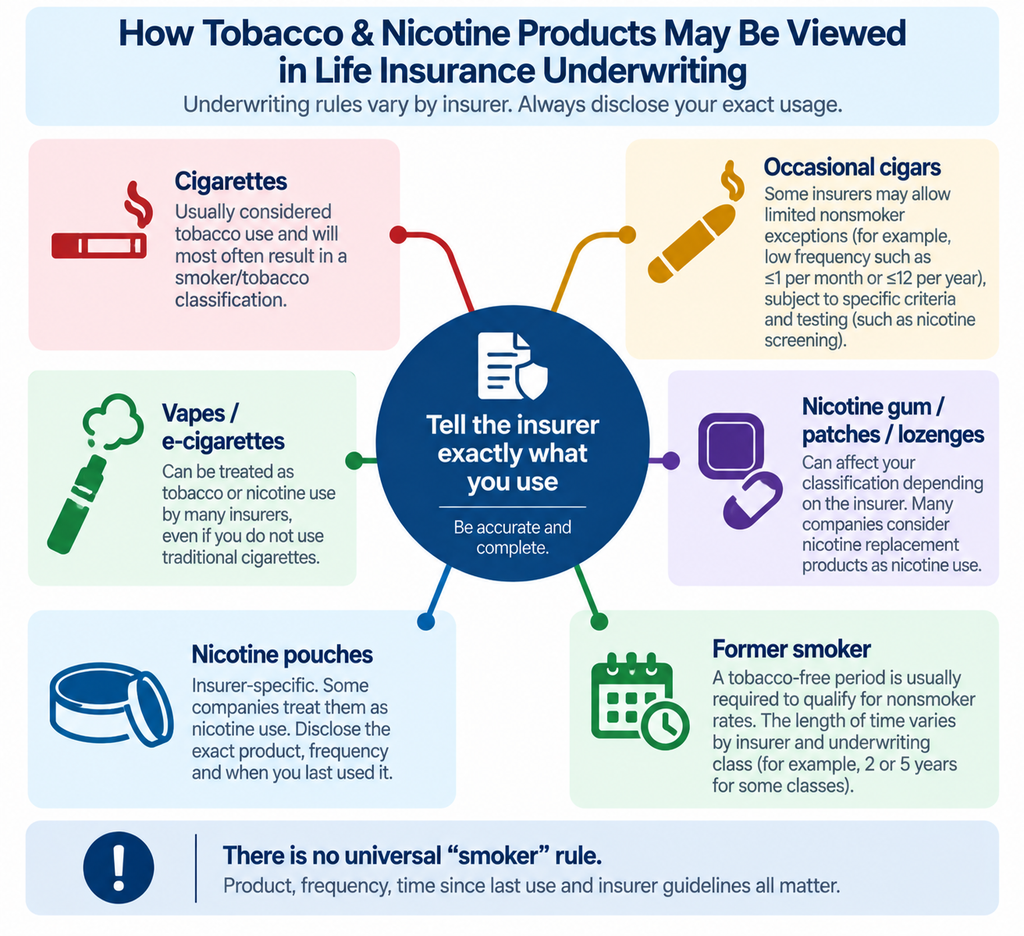
Generic articles often group every product into:
Smoker = tobacco rates.
That is too simplistic.
Regular cigarette smoking will generally lead to tobacco/smoker classification.
But occasional cigar use can be treated differently by certain insurers.
Banner and Transamerica are good current examples.
Both publish circumstances under which limited cigar use may still be compatible with certain non-tobacco classifications.
Those exceptions can depend on:
- Frequency
- Accurate disclosure
- Nicotine/cotinine test results
- Other tobacco use
- Overall underwriting class
Someone smoking one celebratory cigar several times per year is therefore not necessarily underwritten identically to someone smoking a pack of cigarettes per day.
But you should never assume the exception applies before the insurer confirms it.
What About Vaping and E-Cigarettes?
This is one of the most important corrections to the old article.
Do not state:
“Vaping is always treated exactly like cigarette smoking by every insurer.”
But also do not assume:
“I vape instead of smoke, so I am a nonsmoker.”
Current insurer guidelines show why.
Transamerica’s current field guide explicitly includes e-cigarettes and vapes within its tobacco-use definition.
John Hancock similarly tells applicants to disclose e-cigarette and vaping use and has underwriting materials in which vaping can result in tobacco classification.
Protective notes that some carriers include electronic cigarettes within smoking/nicotine classifications.
The safest conclusion is:
Vaping can lead to tobacco or nicotine rates, but exact classification is insurer-specific.
When requesting quotes, state exactly what you use rather than simply answering based on how you personally define “smoker.”
What About Nicotine Gum, Patches and Lozenges?
This is another area where insurer rules matter.
Someone might say:
“I quit cigarettes six months ago, but I still use nicotine gum, so I’m a nonsmoker.”
An insurance company may not agree.
Transamerica’s current tobacco definition includes nicotine:
- Gum
- Patches
- Lozenges
John Hancock also tells applicants to disclose nicotine-replacement products.
That does not prove every insurer treats all nicotine-replacement therapy identically.
It means you should report it accurately and ask how the carrier classifies it.
If you are quitting smoking under medical guidance, do not stop prescribed or recommended cessation treatment simply to influence a life insurance application.
Your health should come first.
What About Nicotine Pouches?
Nicotine pouches create the same general problem: they contain nicotine even though they are not cigarettes.
Underwriting practices can vary and can change as products evolve.
Do not assume that a tobacco-free pouch automatically qualifies you for non-tobacco rates.
When applying, disclose:
- The exact product
- Whether it contains nicotine
- Frequency of use
- When it was last used
and allow the insurer to apply its current underwriting guideline.
Can Marijuana Affect Smoker Rates?
Possibly.
Marijuana and tobacco should not automatically be treated as identical, but insurers can ask about marijuana use separately.
Frequency, method of consumption, medical versus recreational use and other underwriting factors may matter.
For example, Banner’s current FAQ states that some occasional cannabis use can be considered within favorable underwriting classifications depending on circumstances.
John Hancock also tells applicants to disclose marijuana use.
This is another reason not to answer an application based on what you personally consider “smoking.”
Answer the insurer’s actual questions accurately.
How Much More Does Life Insurance Cost for Smokers?
There is no responsible universal percentage.
You will frequently see claims such as:
“Smokers pay 2x.”
or:
“Smokers pay 3–4x more.”
Those numbers may be true in a specific quote comparison but they are not universal pricing rules.
The difference depends on:
- Applicant age
- Sex
- Tobacco classification
- Health
- Coverage amount
- Term
- State
- Company
- Final underwriting class
- Current rate schedule
Banner, for example, changed OPTerm rates in August 2026.
That illustrates why a static article should not claim one company is permanently the cheapest for smokers.
Compare matched quotes instead.
A Better Way to Compare Smoker Quotes
Use:
Same applicant + same tobacco history + same coverage + same term + same state + same quote date
Then record the final offer.
| Question | Company A | Company B | Company C |
|---|---|---|---|
| Product | ________ | ________ | ________ |
| Death benefit | $________ | $________ | $________ |
| Term length | ______ | ______ | ______ |
| Tobacco/nicotine disclosed | ________ | ________ | ________ |
| Frequency of use | ________ | ________ | ________ |
| Initial quote | $________ | $________ | $________ |
| Final underwriting class | ________ | ________ | ________ |
| Final premium | $________ | $________ | $________ |
| Possible future rate reconsideration? | ________ | ________ | ________ |
| Requirements for reconsideration | ________ | ________ | ________ |
A company quoting Preferred Tobacco may be less expensive than another company quoting Standard Tobacco.
The insurer’s underlying rate schedule also matters.
Therefore, do not assume identical class names mean identical prices.
How Long After Quitting Until You Get Nonsmoker Rates?
There is no universal waiting period.
This is one of the most important points in this article.
Transamerica’s current Trendsetter guidelines use different tobacco-free periods depending on the requested nonsmoker classification, including two years for several classes and five years for Preferred Plus.
John Hancock has a different concept for certain existing policies: eligible policyholders can request rate reconsideration after meeting its tobacco-free requirements, including at least 12 months without tobacco or nicotine in the circumstances it describes.
Other companies use different guidelines.
Therefore:
1 year tobacco-free ≠ automatically nonsmoker everywhere
2 years tobacco-free ≠ automatically Preferred everywhere
5 years tobacco-free ≠ guaranteed Preferred Plus everywhere
The company and complete health profile still matter.
Should You Wait Until You Quit Before Buying Life Insurance?
Not necessarily.
Suppose your family needs $750,000 of protection today.
Waiting two years solely to try to obtain lower nonsmoker rates creates two years during which that financial need may remain uninsured.
A more practical approach can be:
Apply for appropriate coverage now.
Then, if you quit:
- Ask whether your insurer allows rate reconsideration.
- Check the required tobacco-free period.
- Compare replacement coverage later if necessary.
- Do not cancel an existing policy until replacement coverage is approved and active.
Whether buying now or waiting makes sense depends on your immediate insurance need.
If people depend financially on you, coverage timing deserves consideration alongside price.
Can You Reapply After Quitting?
Yes.
If you become eligible for more favorable underwriting later, there are generally two broad possibilities:
Ask your current insurer for reconsideration
Some insurers may allow this under their rules.
Apply for a new policy
Another company may provide a better offer after you have established a longer tobacco-free history.
But applying for a new policy means:
- You are older.
- Your health is reassessed.
- New underwriting applies.
- Current pricing applies.
- Approval is not guaranteed.
Do not cancel the old policy before the new policy is approved and in force.
A lower hypothetical nonsmoker quote is not replacement coverage.
Will a Life Insurance Medical Exam Detect Nicotine?
It can.
Life insurance medical underwriting may include blood and urine testing, and insurers can test for cotinine, a nicotine metabolite.
Banner and Transamerica specifically reference nicotine/cotinine testing in their occasional-cigar guidelines.
An insurer may also review other information obtained during underwriting.
That is why attempting to hide smoking or nicotine use is a bad strategy.
Accurate disclosure matters more than trying to temporarily manipulate a test result.
Why You Should Disclose Smoking Honestly
Answer the tobacco and nicotine questions exactly as asked.
Do not decide:
“I only smoke socially, so I’ll put no.”
or:
“Vaping doesn’t count as smoking.”
The insurer determines its underwriting definition.
Protective explicitly advises applicants to disclose even light or social smoking.
Misrepresenting material information can create problems with underwriting and potentially with a later claim, particularly during the policy’s contestability period.
If the application wording is unclear, ask the insurer or licensed agent what should be disclosed.
Smoker Life Insurance Application Worksheet
Before requesting quotes, write down:
Current product used: __________________
Cigarettes per day/week: __________________
Cigars per month/year: __________________
Vaping/e-cigarette frequency: __________________
Chewing tobacco/snuff use: __________________
Nicotine pouch use: __________________
Nicotine-replacement therapy: __________________
Date of last cigarette: __________________
Date of last tobacco/nicotine use: __________________
Previous quit attempts: __________________
Other tobacco or marijuana use: __________________
Coverage needed: $__________________
Desired term: __________ years
Use the same information when requesting comparisons from different insurers.
Otherwise you may accidentally compare quotes built on different assumptions.
How Much Coverage Should a Smoker Buy?
Smoking affects your underwriting.
It should not determine how much life insurance you actually need.
Calculate the financial need first.
Possible obligations include:
- Income replacement
- Mortgage
- Debts
- Childcare
- Education
- Support for a spouse
- Other dependents
- Final expenses
Then subtract available savings and existing dependable coverage.
Do not reduce a $750,000 family-protection need to $250,000 just because tobacco rates make $750,000 more expensive without first understanding the financial consequence.
If the ideal amount is currently outside your budget, compare alternatives such as:
- Different insurers
- Different term lengths
- Layered policies
- Reassessing nonessential riders
- Reviewing coverage again after quitting
The objective is to balance meaningful protection with a premium you can actually maintain.
Common Mistakes Smokers Should Avoid
Assuming every insurer defines tobacco use identically. They do not.
Calling yourself a nonsmoker because you vape. Several insurers explicitly classify vaping or nicotine use within their tobacco rules.
Assuming occasional cigars always receive smoker rates. Certain carriers publish limited exceptions.
Assuming occasional cigars always receive nonsmoker rates. The exception depends on frequency, testing and insurer rules.
Hiding smoking from the application. Accurate disclosure is essential.
Using a universal “wait one year” rule. Nonsmoker eligibility periods vary.
Waiting years for lower rates while leaving an important financial need uninsured. Consider whether buying appropriate coverage now is more important.
Cancelling a smoker-rate policy before replacement is approved. Never assume a future application will be accepted.
Choosing guaranteed-issue insurance simply because you smoke. Smoking alone does not mean you cannot qualify for traditional term coverage.
Frequently Asked Questions
Can smokers get term life insurance? Yes. Many traditional insurers offer term coverage to tobacco users through smoker or tobacco underwriting classes.
What is the best life insurance company for smokers? There is no universal winner. Banner, Transamerica, Protective and John Hancock are all worth investigating because their current materials provide meaningful tobacco-related underwriting information. The best offer depends on your usage pattern, health and final underwriting result.
Is Banner Life good for smokers? Banner offers Preferred Tobacco and Standard Tobacco classes on OPTerm and publishes specific criteria under which limited occasional cigar use may still be considered for certain non-tobacco classifications.
Does vaping count as smoking for life insurance? It can. Transamerica explicitly includes vapes and e-cigarettes in its current tobacco-use definition, and John Hancock also instructs applicants to disclose vaping. Rules can vary by insurer.
Does nicotine gum count as tobacco use? Some insurers classify or evaluate nicotine-replacement products within their tobacco/nicotine rules. Transamerica currently includes nicotine gum, patches and lozenges in its tobacco-use definition. Disclose the exact product rather than assuming.
Can occasional cigar smokers get nonsmoker rates? Potentially with some insurers. Banner and Transamerica currently publish limited cigar exceptions under specific frequency, disclosure, testing and underwriting requirements.
How long do I have to stop smoking before getting nonsmoker rates? There is no universal period. Some insurers and underwriting classes require different periods. Transamerica currently uses different look-back periods depending on class, while John Hancock offers a separate reconsideration process for certain existing policies after qualifying cessation.
Can I lower my premium if I quit smoking after buying life insurance? Possibly. Some insurers allow rate reconsideration after a required tobacco-free period. John Hancock currently documents such a process for eligible policies, subject to reevaluation and product rules.
Will a life insurance medical exam detect nicotine? It can. Underwriting can include cotinine or other nicotine testing, and insurers may also use medical and prescription information.
Should I lie about occasional smoking to get a lower rate? No. Disclose tobacco and nicotine use accurately. Insurers can verify information during underwriting, and material misrepresentation can cause serious problems.
Should I wait until I quit before buying life insurance? Not automatically. If your family currently has an important uninsured financial need, waiting solely for potentially lower rates may leave that risk unprotected. You can investigate coverage now and reevaluate your options after establishing a tobacco-free history.
Does smoking mean I need guaranteed-issue insurance? No. Many smokers qualify for ordinary traditionally underwritten term or permanent life insurance. Guaranteed issue addresses different underwriting situations and generally provides much smaller death benefits.


