
Introduction
How much life insurance you need cannot be answered with one number that works for everyone.
You may see shortcuts such as:
- 5 times your income
- 10 times your income
- 10 times income plus college costs
- Enough to pay off the mortgage
These formulas can provide a rough starting point, but they do not know anything about your actual household.
Two people earning the same salary can need completely different amounts of life insurance.
One may have three children, a mortgage and a spouse who depends heavily on their income.
The other may be single, have no dependents and have substantial savings.
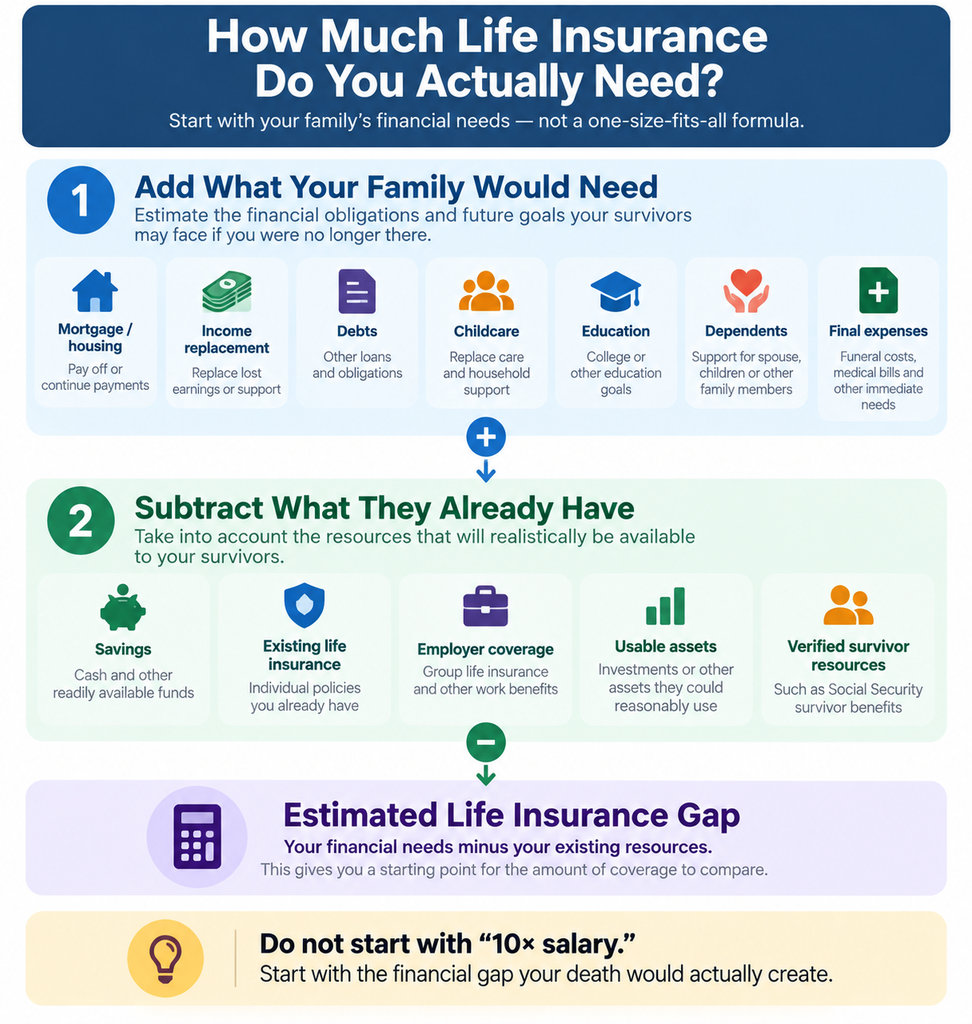
Quick answer: Estimate the financial obligations your survivors would face, add the income or services that would need to be replaced, include important future goals, and then subtract savings, existing life insurance and other resources that would realistically be available. The result is your estimated life insurance gap—not an automatic policy recommendation, but a much better starting point than a universal salary multiple.
A Simple Life Insurance Needs Formula
A useful starting formula is:
Immediate obligations + income replacement + future financial goals + other dependent needs − existing resources = estimated life insurance gap
In practice:
| Add | Subtract |
|---|---|
| Mortgage or housing need | Savings available to survivors |
| Other debts that would remain | Existing individual life insurance |
| Income replacement | Reliable employer coverage |
| Childcare or household services | Other assets intended for survivors |
| Education goals | Verified survivor benefits or other dependable income |
| Final expenses | Other resources specifically available for these needs |
| Support for other dependents | |
| Business obligations |
The objective is not to produce a perfectly precise number.
It is to identify the approximate financial gap your death would create.
Step 1: Identify Who Actually Depends on You
Before calculating a death benefit, ask:
Who would be financially affected if I died today?
Possible answers include:
- Spouse
- Partner
- Children
- Parents
- Siblings
- Other relatives
- Business partner
- Employees
- Another dependent
If nobody depends financially on you, your insurance need may be relatively small.
If several people depend heavily on your income or unpaid household work, your need can be much larger.
This is why life insurance should begin with financial dependency, not a salary formula.
Step 2: Calculate Immediate Financial Obligations
Start with expenses that could need to be addressed shortly after death.
These may include:
- Mortgage balance
- Other debts
- Final expenses
- Medical bills
- Business obligations
- Emergency cash needs
Do not automatically include every debt.
The important question is:
Would this obligation actually create a financial burden for my survivors?
For example, the treatment of a jointly held mortgage can be very different from a debt that would not remain someone else’s financial responsibility.
Should You Include the Entire Mortgage?
Not automatically.
Suppose your mortgage balance is:
$300,000
There are several possible approaches.
You might want life insurance sufficient to:
Pay off the entire mortgage
or simply:
Provide enough income so the surviving spouse can continue making payments.
Those are different objectives.
If the surviving spouse has substantial income and savings, paying off the entire mortgage may not be necessary.
If losing your income would make the home unaffordable, the mortgage may represent a much larger part of the insurance need.
Ask:
What would my family realistically want and need to do with the home if I died?
Then calculate around that outcome.
Step 3: Estimate Income Replacement
For many working adults, this is the largest part of the calculation.
But replacing income does not necessarily mean:
Annual salary × arbitrary multiplier
Instead, estimate the actual annual household shortfall.
Suppose you earn:
$80,000 per year
but your household determines that after your death it would need:
$45,000 per year
to replace the part of your income that currently supports:
- Housing
- Food
- Utilities
- Transportation
- Child expenses
- Savings goals
- Other household costs
If that support is needed for approximately:
15 years
a simple starting calculation is:
$45,000 × 15 = $675,000
This is deliberately a simplified calculation.
It does not account precisely for investment returns, inflation, taxes or changing household expenses.
But it is more useful than automatically saying:
$80,000 × 10 = $800,000
without examining what the family actually needs.
How Many Years of Income Should You Replace?
There is no universal answer.
Possible endpoints include:
- When children become financially independent
- When a spouse reaches retirement
- When the mortgage is paid off
- When significant assets become available
- When another income source begins
- When a business obligation ends
For example:
Applicant age: 38
Youngest child: 4
Expected support until approximately age 22
Potential child-support period:
18 years
But income replacement may not need to remain at the same level for all 18 years.
Your household needs can decline over time.
That is one reason a needs-based calculation is more useful than a single salary multiple.
Step 4: Include Childcare and Household Work
Income is not the only financial contribution that can require replacement.
A stay-at-home parent can have a significant life insurance need even if they earn:
$0 in employment income.
Consider the cost of replacing responsibilities such as:
- Childcare
- Transportation
- Meal preparation
- Household management
- Cleaning
- Scheduling
- Care for relatives
If the surviving parent would need to:
- Pay for childcare
- Reduce work hours
- Hire household help
- Change jobs
then the death of a non-working parent can still create a substantial financial loss.
Do not conclude:
“No salary = no life insurance need.”
Step 5: Include Education Goals Carefully
Some families want life insurance to help fund:
- College
- Vocational training
- Other education
If that is part of your financial plan, include an amount.
But separate:
essential financial protection
from:
optional financial goals.
For example:
Income replacement: essential
Mortgage support: essential
$200,000 college goal: household planning decision
There is nothing wrong with including education.
It should simply be identified as a deliberate goal rather than automatically added to every life insurance calculation.
Step 6: Consider Support for Other Dependents
Children and spouses are not the only dependents.
You may financially support:
- Aging parents
- A sibling
- A relative with a disability
- Another family member
Estimate:
Annual support × expected number of years
and consider whether another family member could replace that support.
A dependent who may require lifelong assistance can also create a permanent insurance need rather than a temporary one.
That distinction may affect whether term or permanent coverage deserves consideration.
Our Term Life vs. Whole Life Insurance guide explains that difference.
Step 7: Add Final Expenses, but Do Not Use a Universal Funeral Number
Final expenses can include more than a funeral.
Possible costs include:
- Burial or cremation
- Funeral services
- Travel
- Medical bills
- Legal or administrative expenses
- Immediate household expenses
The correct amount depends on:
- Location
- Type of funeral
- Family preferences
- Existing arrangements
- Savings already designated for those costs
Do not automatically add an arbitrary $20,000 or $30,000 simply because an online calculator does.
Use an amount that reflects your situation.
Step 8: Subtract Savings and Assets That Would Actually Be Available
Once you estimate the financial need, subtract resources that can realistically reduce that gap.
Possible resources include:
- Cash savings
- Brokerage assets
- Existing individual life insurance
- Employer life insurance
- Other liquid assets
- Certain retirement assets
- Survivor income
But be careful.
Not every asset should automatically be treated as available.
For example, using an entire retirement portfolio immediately after death may undermine the surviving spouse’s own retirement security.
Similarly, the family home may have significant equity but may not be an asset the family wants or is able to sell.
Ask:
Would we realistically use this asset to meet this financial need?
Only then subtract it.
Step 9: Include Existing Life Insurance
If you already have:
$250,000 individual policy
and:
$100,000 employer coverage
your current gross life insurance is:
$350,000
That should be considered before buying additional coverage.
But employer coverage deserves additional scrutiny.
Ask:
- Is the benefit guaranteed to remain while I work there?
- What happens if I change jobs?
- Can I take it with me?
- Is supplemental coverage portable?
- Does the cost rise with age?
Our Group vs. Individual Life Insurance guide explains why employer coverage and personally owned coverage are not identical.
Step 10: Consider Social Security Survivor Benefits — but Verify Them First
Some surviving spouses, children and dependent parents may qualify for Social Security survivor benefits based on the deceased worker’s earnings record.
That can reduce the household income gap in some situations.
But do not simply subtract an estimated Social Security number from an online article.
Eligibility and benefit amounts depend on the individual situation.
A better approach is:
- Review your Social Security record.
- Estimate which family members could qualify.
- Determine the approximate benefit.
- Only then consider it as part of the household’s survivor resources.
Social Security should be treated as one potential resource—not a universal substitute for life insurance.
What About Federal Student Loans?
Do not automatically add federal student loan balances to your life insurance requirement.
Federal student loans may be discharged upon the death of the borrower after the required documentation is provided. Parent PLUS loans can also have death-discharge provisions involving the borrower or student.
Private student loans are different.
Review:
- The loan contract
- Death-discharge provisions
- Co-signer obligations
- Applicable state law
Do not assume all student debt behaves the same way.
The Life Insurance Gap Method
After gathering the numbers, calculate:
A. Immediate obligations
Mortgage/housing need: $________
Other debts: $________
Final expenses: $________
Emergency fund for survivors: $________
Business obligations: $________
Subtotal A: $________
B. Income replacement
Annual household income shortfall: $________
Number of years needed: ______
Income-replacement estimate: $________
C. Future goals
Education: $________
Dependent support: $________
Other major goals: $________
Subtotal C: $________
D. Existing resources
Savings available to survivors: $________
Existing individual life insurance: $________
Reliable employer life insurance: $________
Other usable assets: $________
Verified survivor income/resources: $________
Subtotal D: $________
Estimated coverage gap
A + B + C − D = $________________
That number is your starting point.
It is not a requirement to buy precisely that amount.
A Full Example
Consider a hypothetical household.
Applicant: 40-year-old parent
Spouse: employed
Children: ages 5 and 8
Immediate obligations
Mortgage support:
$250,000
Other debt:
$20,000
Final/emergency expenses:
$25,000
Subtotal:
$295,000
Income replacement
The family estimates it would face an annual income shortfall of:
$35,000
for approximately:
15 years
Simple estimate:
$35,000 × 15 = $525,000
Education
Desired education funding:
$100,000
Total need
$295,000 + $525,000 + $100,000 = $920,000
Existing resources
Savings available to survivors:
$100,000
Employer life insurance:
$100,000
Existing individual policy:
$50,000
Total resources:
$250,000
Estimated gap
$920,000 − $250,000 = $670,000
The family now has a useful comparison target.
They might investigate available policies around:
- $650,000
- $750,000
- Another nearby coverage level
depending on available product bands, budget and how conservatively they want to plan.
The lesson is not:
“Everyone needs $670,000.”
It is that the amount came from the household’s actual financial situation.
Why You May Choose a Little More Than the Exact Calculation
Life insurance planning contains uncertainty.
You do not know precisely:
- Future inflation
- Future household expenses
- Investment returns
- Future education costs
- How quickly a spouse may return to work
- Whether plans will change
Therefore, some households may intentionally choose a death benefit somewhat above the estimated gap.
For example:
Calculated gap: $670,000
Available policy amount:
$750,000
Choosing $750,000 could provide additional margin.
That does not mean:
“Always round up.”
Compare the extra premium with the value of the additional protection.
More Coverage Is Not Automatically Better
There is also a point where additional coverage may provide little benefit relative to its cost.
Suppose your realistic financial need is:
$400,000
Buying:
$2 million
simply because you qualify for it may not be an efficient use of your insurance budget.
Every dollar spent on unnecessary coverage is money unavailable for other financial priorities.
The objective is:
adequate coverage
not:
maximum possible coverage.
Do Not Reduce the Death Benefit Just to Afford Whole Life
This is an especially important mistake to avoid.
Suppose your household needs:
$1 million of protection for 20 years
but your budget allows either:
$1 million term life
or:
$150,000 whole life
Those policies do not solve the same problem.
If the $1 million need is real, reducing coverage to $150,000 simply to obtain permanent insurance and cash value could leave the household substantially underinsured.
Calculate the death benefit first.
Then decide which policy structure can realistically provide it.
How Long Do You Need Life Insurance?
Amount and duration are separate questions.
You might need:
$1 million today
but not necessarily for life.
Potential timelines include:
- Until children are independent
- Until retirement
- Until the mortgage is substantially reduced
- Until sufficient assets are accumulated
- Until a business debt ends
Our 10-Year vs. 20-Year vs. 30-Year Term Life Insurance guide explains how to match the term to these timelines.
Your Coverage Need Can Decline Over Time
Imagine a young family.
Today they have:
- $400,000 mortgage
- Two young children
- Limited savings
- Large income-replacement need
Twenty years later they may have:
- $100,000 mortgage
- Independent children
- Significant retirement savings
- Much smaller income-replacement need
Their required death benefit may therefore decline.
One strategy sometimes considered is term laddering.
For example:
$500,000 — 10-year term
$500,000 — 20-year term
$500,000 — 30-year term
Initial coverage:
$1.5 million
After 10 years:
$1 million
After 20 years:
$500,000
This is only an illustrative structure.
Multiple policies add complexity, and laddering is not automatically cheaper or better than one policy.
How Much Life Insurance Does a Young Family Need?
Families with young children often have relatively large protection needs because several obligations overlap:
- Income replacement
- Mortgage
- Childcare
- Education
- Other debt
- Long period before financial independence
But even two young families with the same income may need different amounts.
Our Best Life Insurance for Young Families guide examines those decisions in more detail.
How Much Life Insurance Does a Stay-at-Home Parent Need?
Do not start with income.
Start with:
What would the surviving household have to pay to replace the work this person currently performs?
Possible costs include:
- Childcare
- Transportation
- Meal preparation
- Household work
- Schedule management
Also consider whether the surviving working parent would:
- Reduce work hours
- Take extended leave
- Change jobs
The death benefit should reflect the economic impact, not just wages.
How Much Life Insurance Does a Single Person Need?
A single person with no dependents may have a relatively small need.
Possible reasons for coverage include:
- Final expenses
- Financial support for parents
- Co-signed private debt
- Business obligations
- A future need expected soon
But someone who:
- Has no dependents
- Has no co-signed obligations
- Has enough savings for final expenses
may not need substantial coverage today.
Life insurance should solve an existing or reasonably foreseeable financial risk, not simply be purchased because someone is young.
How Much Life Insurance Do Seniors Need?
Coverage needs often change approaching or after retirement.
A senior may no longer need decades of income replacement.
But potential needs can remain:
- Spouse support
- Mortgage
- Final expenses
- Other dependents
- Estate liquidity
- Business obligations
- Legacy goals
Do not automatically assume:
Senior = $10,000–$25,000 final-expense policy.
Our Life Insurance for Seniors Over 60 guide explains the available options and how senior needs can differ significantly.
What About Life Insurance Through Work?
Employer coverage can be useful, but it should be evaluated separately.
Suppose your employer provides:
2× salary = $160,000
and your calculated household gap is:
$900,000
You still have approximately:
$740,000
of uncovered need if you count the employer coverage fully.
And because employment can change, you should investigate whether that $160,000:
- Ends when employment ends
- Can be ported
- Can be converted
- Changes in cost
Do not let an employer benefit stop you from calculating the actual gap.
Should You Include Inflation?
Ideally, long-term planning should consider that future dollars may buy less than today’s dollars.
But there is no need to pretend that a simple online calculation can precisely forecast inflation for the next 20 or 30 years.
Possible approaches include:
- Building a reasonable margin into the death benefit
- Using professional financial-planning calculations
- Reviewing the policy periodically
- Increasing coverage if the financial need grows
The important thing is to recognize that a calculation based entirely on today’s costs contains uncertainty.
Life Insurance Needs Gap Worksheet
Step 1 — Immediate needs
Mortgage/housing: $________
Other debts: $________
Final expenses: $________
Emergency cash: $________
Business obligations: $________
Immediate-needs subtotal: $________
Step 2 — Income replacement
Annual household shortfall without your income: $________
Years support is needed: ______
Simple income-replacement estimate: $________
Step 3 — Future goals
Education: $________
Dependent support: $________
Other financial goals: $________
Future-goals subtotal: $________
Step 4 — Resources
Savings realistically available: $________
Existing individual life insurance: $________
Employer life insurance: $________
Other usable assets: $________
Verified survivor benefits/income: $________
Resources subtotal: $________
Step 5 — Calculate the gap
Immediate needs
- Income replacement
- Future goals
− Existing resources
=
Estimated Life Insurance Gap: $________________
Then answer:
- How many years does this financial need last?
- Which parts are temporary?
- Which parts are genuinely lifelong?
- Does employer coverage depend on keeping my current job?
- Have I included the economic value of unpaid caregiving?
- Am I subtracting assets my family would realistically use?
- Have I verified any survivor benefits I am counting?
- Would a health change make replacing a short policy difficult later?
- Can I comfortably maintain the proposed premium?
- When will I review this calculation again?
When Should You Recalculate Your Life Insurance Need?
Life insurance should not necessarily be a “buy once and never look again” decision.
Review your need after major changes such as:
- Marriage
- Divorce
- Birth or adoption
- Buying a home
- Significant salary change
- New business
- Major debt
- Retirement
- Children becoming independent
- Paying off the mortgage
- Significant increase in savings
- Death of a beneficiary
- Changes in dependent-care responsibilities
A calculation that was appropriate at age 30 may be completely different at age 50.
How Often Should You Review the Policy?
There is no universal mandatory schedule.
A practical approach is to review coverage periodically and whenever a major financial or family event occurs.
Ask:
Has the amount changed?
and:
Has the duration changed?
You may discover that you need:
- More coverage
- Less coverage
- A longer term
- A different policy structure
- No additional coverage at all
The review should follow the financial need.
Common Mistakes When Calculating Life Insurance Needs
Using a salary multiple as the final answer. Salary alone does not describe dependents, debts, savings or duration.
Adding the entire mortgage automatically. Determine whether paying it off is actually the household objective.
Ignoring the economic value of a stay-at-home parent. Unpaid work can still be expensive to replace.
Ignoring employer coverage. It should be counted when appropriate, while considering portability.
Counting assets that survivors cannot realistically use. Not all household wealth is available for immediate spending.
Automatically insuring federal student loans. Federal student loans may be discharged after the borrower’s death.
Ignoring other dependents. Parents or relatives may rely on your support.
Buying the maximum coverage you qualify for. Qualification does not determine need.
Buying too little permanent insurance instead of enough term coverage. Protect the required death benefit first.
Ignoring duration. Amount and term are separate decisions.
Never reviewing the calculation again. Financial responsibilities change.
Frequently Asked Questions
How much life insurance do I need? Estimate your immediate obligations, income-replacement need, dependent support and future goals, then subtract savings, existing coverage and other resources realistically available to survivors.
Is 10 times salary enough life insurance? It may be too much, too little or approximately right depending on the household. A salary multiple does not account for debts, dependents, savings, employer coverage or the duration of the financial need.
Is $500,000 of life insurance enough? It depends entirely on your financial gap. For one household $500,000 could be more than necessary; for another it could leave a substantial shortfall.
Is $1 million of life insurance too much? Not necessarily. A family with high income-replacement needs, young children and a mortgage may reasonably calculate a need around or above $1 million. The amount should come from the financial need rather than the size of the number.
Should life insurance pay off my entire mortgage? Not automatically. Decide whether your goal is eliminating the mortgage or providing enough money for survivors to continue making payments.
How many years of income should life insurance replace? There is no universal number. Estimate how long the household would actually depend on the deceased person’s financial contribution.
Does a stay-at-home parent need life insurance? Potentially. Childcare and household services can have significant replacement costs even when the parent has no employment income.
Do single people need life insurance? Sometimes. Financial support for relatives, co-signed obligations, business needs or final expenses can create a need. Someone with no dependents and adequate assets may need little or no substantial coverage.
Should I include employer life insurance in my calculation? Yes, if it is reliable and available to survivors, but consider whether the coverage disappears or changes if you leave your job.
Should I count Social Security survivor benefits? Potentially, but verify eligibility and estimated benefits first. Certain spouses, children and dependent parents may qualify.
Do I need life insurance to pay federal student loans? Federal student loans may be discharged upon the borrower’s death after the required documentation is provided. Private loan terms can differ.
Should I buy more coverage than my calculation says? Some households choose a reasonable margin for uncertainty, but more coverage is not automatically better. Compare the additional protection with the additional premium.
How often should I recalculate my coverage? Review it after major family or financial changes and periodically as debts, savings, dependents and income change.
Should I calculate the death benefit before choosing term or whole life? Yes. Determine the financial need first, then choose a policy structure capable of providing adequate coverage for the required duration.