


Introduction
Term life insurance can provide a large death benefit during the years when your family, mortgage or other financial obligations create the greatest need for protection.
But there is no single term life insurance company that is best for every applicant.
One company may offer a 40-year term. Another may allow a particularly large death benefit. Another may be more useful for someone who wants an accelerated underwriting process or needs coverage at an older age.
The final premium can also change significantly after underwriting.
Quick answer: Our 2026 shortlist includes Banner Life for its broad OPTerm menu and accelerated-underwriting options, Protective for long terms and very high coverage amounts, Pacific Life for its low starting face amount and flexible underwriting, Corebridge Financial for unusually precise term lengths, and USAA for its streamlined Eagle Express product and military-specific features. These are starting points for comparison, not universal winners.
How We Selected Our 2026 Shortlist
We did not rank companies based on affiliate payouts, a single sample premium or advertising claims.
For this comparison, we reviewed current insurer product materials and focused on factors that affect how useful a term policy can be:
- Available term lengths
- Coverage ranges
- Issue-age limits
- Level-premium structure
- Accelerated or exam-free underwriting opportunities
- Conversion provisions
- Rider availability
- Flexibility for unusual coverage periods
- Product availability and state restrictions
- Quality and recency of insurer documentation
We do not name a “cheapest company” because a fair price comparison requires matched applicant assumptions and an actual underwriting result.
The best company for you may not be the company that looks strongest in a general comparison table.
Best Term Life Insurance Companies in 2026 at a Glance
| Company | Product | Term Options | Coverage | Why It Stands Out |
|---|---|---|---|---|
| Banner Life | OPTerm | 10, 15, 20, 25, 30, 35, 40 years | $100,000+ | Broad term menu and substantial accelerated-underwriting limits |
| Protective | Classic Choice Term | 10–40 years | $100,000–$50 million on current consumer materials | Very high potential coverage and long-term options |
| Pacific Life | PL Promise Term | 10, 15, 20, 25, 30 years | Starts at $50,000 | Low minimum, later-life availability and PAL+ underwriting |
| Corebridge Financial | Select-a-Term | 18 durations from 10 to 35 years | Subject to product and underwriting limits | Unusually precise term-length matching |
| USAA | Eagle Express | 10–30 years | $100,000–$10 million | Streamlined application and military-specific features |
Coverage, maximum issue ages and underwriting availability can vary by term length, state and applicant.
The table should therefore help you decide which companies deserve a quote, not which one you should automatically buy.
Banner Life — Worth Investigating for Term-Length Flexibility
Banner Life’s OPTerm is one of the broadest traditional term products in this comparison.
Current options include:
- 10 years
- 15 years
- 20 years
- 25 years
- 30 years
- 35 years
- 40 years
Coverage begins at $100,000.
Banner currently lists overall OPTerm issue ages from 20 through 75, but the maximum age becomes lower for longer terms and can also differ by tobacco class.
For example, someone who qualifies for a 10-year term at an older age should not assume they can also purchase a 30- or 40-year policy.
Where Banner’s underwriting stands out
Banner has also expanded its accelerated-underwriting program.
Its current 2026 materials state that qualifying applicants ages 20–60 may be eligible for accelerated underwriting for up to $5 million of OPTerm coverage.
Some qualifying applicants can receive an instant or exam-free decision.
Applicants who do not qualify for the accelerated route can be moved into another appropriate underwriting pathway rather than automatically being declined.
That distinction matters.
Accelerated underwriting is not the same as guaranteed no-exam insurance.
Health history, build, lifestyle, financial information and other factors can affect eligibility.
Banner may deserve a closer look if:
- You want a 35- or 40-year term.
- You need at least $100,000 of coverage.
- You want to investigate accelerated underwriting.
- You value a broad range of standard term lengths.
- You want a traditional convertible term product.
One state-specific point is important: Banner Life itself does not issue policies in New York. William Penn Life Insurance Company of New York serves that market under separate product rules.
Protective — Worth Investigating for Long Terms and High Coverage
Protective Classic Choice is another unusually flexible term product.
Protective currently advertises terms from:
10 to 40 years
and consumer-facing materials list coverage from:
$100,000 to $50 million
subject to underwriting and financial justification.
That upper limit makes Protective worth investigating for applicants who have a legitimately large insurance need.
A $20 million or $30 million policy is not something an applicant can simply select because they want it.
The insurer will generally evaluate whether the requested amount is financially justified.
Conversion is another strength
Protective Classic Choice includes conversion options that may allow eligible term coverage to be converted to permanent insurance without new medical underwriting, subject to the policy’s conversion rules.
Protective also offers different conversion-related features depending on product and state.
That can matter if your health changes later.
But do not choose a policy solely because it says “convertible.”
Check:
- Conversion deadline
- Maximum conversion age
- Which permanent policies are available
- Whether partial conversion is allowed
- Premium after conversion
Protective may deserve a closer look if:
- You need a 35- or 40-year term.
- You have a very large financially justified coverage need.
- Conversion flexibility matters.
- You want a traditional fully underwritten policy.
- Its actual underwriting result is competitive for you.
The published maximum is a product capability, not evidence that most applicants need or qualify for anything close to $50 million.
Pacific Life — Worth Investigating for Flexibility and a Low Minimum
Pacific Life’s PL Promise Term has a somewhat different profile.
Current level-premium periods include:
- 10 years
- 15 years
- 20 years
- 25 years
- 30 years
Coverage begins at just $50,000.
That lower minimum can make Pacific Life relevant for someone who needs more than final-expense coverage but substantially less than the minimum offered by some competing traditional term products.
Pacific Life currently describes its overall PL Promise Term client profile as ages 18–80.
Again, this does not mean every term length is available through age 80.
Maximum issue age depends on the selected term and underwriting class.
Pacific Accelerated Life+
PL Promise Term also uses Pacific Life’s Pacific Accelerated Life+, or PAL+, underwriting system.
Current Pacific Life materials state that qualifying applicants ages 18–60 can potentially receive up to $3 million of PL Promise Term coverage through an accelerated path without a medical exam.
Eligibility depends on the applicant and underwriting result.
Other applicants may be routed to modified or traditional underwriting.
Conversion
PL Promise Term can currently be converted to the designated PL Promise Conversion UL product during the applicable period without new underwriting, subject to age and policy restrictions.
Pacific Life states that eligible conversion is available during the level-premium period up to age 70.
Pacific Life may deserve a closer look if:
- You need as little as $50,000 of traditional term coverage.
- You want a 25-year term.
- You are an older applicant investigating shorter-term coverage.
- You want to investigate accelerated underwriting.
- A clearly documented conversion route matters to you.
Pacific Life is a good example of why an overall maximum issue age should never be viewed without checking the specific term.
Corebridge Financial — Worth Investigating for Precise Term Lengths
Corebridge Financial’s Select-a-Term has one particularly unusual feature:
18 different term periods.
Current options include:
- 10 years
- 15 years
- 16 years
- 17 years
- 18 years
- 19 years
- 20 years
- 21 years
- 22 years
- 23 years
- 24 years
- 25 years
- 26 years
- 27 years
- 28 years
- 29 years
- 30 years
- 35 years
Why would this matter?
Imagine you have exactly 23 years remaining on a mortgage.
A conventional insurer may force you to choose between a 20-year and 30-year term.
Select-a-Term potentially lets you investigate a 23-year policy instead.
That does not automatically make it cheaper, but it allows the duration of the insurance to match the financial obligation more closely.
Underwriting
Corebridge also uses its Agile Underwriting+ process on eligible business.
The company states that this streamlined process can provide faster decisions and may allow some qualifying applications to proceed without an exam, labs or an attending physician statement.
Again, may is important.
The applicant is still being underwritten.
Corebridge may deserve a closer look if:
- Your financial obligation has an unusual remaining duration.
- You do not want to pay for several unnecessary additional years of coverage.
- You want a term between the standard 20- and 30-year choices.
- You want to investigate streamlined underwriting.
The main advantage here is not a generic claim about price.
It is duration precision.
USAA — Worth Investigating for Military Households and a Streamlined Product
USAA is closely associated with the military community, but its current life insurance products are available to the general public.
Its Eagle Express term product currently offers:
- Coverage from $100,000 to $10 million
- Terms from 10 to 30 years
- Eligibility generally from ages 18 to 70
- Level coverage and premiums during the selected term
USAA also states that some applicants may not need a medical exam.
That does not mean an exam is guaranteed to be waived.
Military-specific features
For eligible servicemembers, USAA also offers military-specific benefits through its current term coverage.
These can include features addressing severe injuries during qualifying military duties and future insurability around separation from military service, subject to rider requirements.
This can make USAA particularly relevant for active-duty servicemembers or military families.
Conversion
Eagle Express currently includes an option to investigate conversion to permanent coverage after the first policy year, subject to eligibility requirements and an expiration date.
Conversion increases the premium.
USAA may deserve a closer look if:
- You are active duty, a veteran or part of a military household.
- Military-specific policy features matter to you.
- You want between $100,000 and $10 million of coverage.
- A 10-, 20- or 30-year range meets your needs.
- You value a streamlined online application.
Someone without military ties can still investigate Eagle Express because USAA currently makes its life insurance available to the public.
Which Company Has the Best No-Medical-Exam Option?
This question needs careful wording.
There is an important difference between:
A policy that never requires a medical exam
and:
A traditionally underwritten policy in which qualifying applicants may have the exam waived.
Banner and Pacific Life are examples of the second category.
Banner currently allows qualifying applicants ages 20–60 to enter its accelerated-underwriting pathway for substantial OPTerm coverage.
Pacific Life’s PAL+ similarly provides an accelerated no-exam pathway for qualifying PL Promise Term applicants.
USAA states that Eagle Express applicants may not need an exam.
Corebridge’s Agile Underwriting+ may also allow certain qualifying applicants to avoid traditional medical requirements.
None of that guarantees that you will avoid an exam.
If avoiding the medical exam is your highest priority, compare these products with dedicated no-medical-exam life insurance options and make sure you understand whether the policy is:
- Accelerated underwritten
- Simplified issue
- Guaranteed issue
They are not the same thing.
Which Company Is Cheapest?
We do not name one.
A responsible price comparison requires the same:
Age
Sex
State
Coverage amount
Term length
Tobacco/nicotine status
Health profile
Quote date
and ideally the same final underwriting class.
Suppose Company A advertises:
$25/month
while Company B appears to cost:
$31/month.
That comparison means little if the first number assumes Preferred Plus and the second applicant ultimately receives Standard.
The final underwriting result is what matters.
Rates also change.
Banner, for example, implemented a new OPTerm rate schedule in August 2026.
A static article claiming one company is permanently cheapest can therefore become outdated very quickly.
How Much Term Life Insurance Do You Need?
Choosing the insurer should come after deciding how much protection you need.
Consider:
- Income your household would lose
- Mortgage or rent obligations
- Other debts
- Childcare
- Education goals
- Financial support for dependents
- Existing savings
- Existing individual life insurance
- Dependable group life insurance
A simple starting framework is:
Financial obligations
− resources already available
= potential coverage gap
Do not automatically buy:
5× income
10× income
or any other universal multiple.
Your actual household obligations provide a better starting point.
For a detailed calculation, use our guide to how much life insurance you actually need.
How Long Should Your Term Be?
The term should generally line up with the period during which the financial risk exists.
Possible reference points include:
- Years remaining on a mortgage
- Age of your youngest child
- Expected retirement date
- Years until a spouse becomes financially independent
- Duration of a business or debt obligation
This is why having more term-length choices can be useful.
If your need lasts approximately 23 years, Corebridge allows you to investigate 23 years directly.
With another insurer, you might decide between 20 and 25 or 30 years.
Do not automatically select the longest available policy.
Longer protection can be useful, but it may also cost more.
Our 10-Year vs. 20-Year vs. 30-Year Term Life Insurance guide goes deeper into choosing the appropriate duration.
What Happens After the Level Term?
A 20-year level-term policy does not necessarily disappear the morning the 20th year ends.
Many policies allow some form of continuation or annual renewal afterward.
But the original level premium generally does not continue indefinitely.
Banner, for example, states that OPTerm premiums can increase annually after the initial level-premium period.
Protective similarly notes that premiums increase after its initial guaranteed level period.
That means you should choose the original term assuming the protection needs to remain affordable during that level period, rather than planning to rely indefinitely on later annual renewals.
The other potential option is conversion to permanent insurance if the policy still permits it.
Conversion deadlines can arrive before the overall policy terminates.
Do Financial Strength Ratings Matter?
Yes, but they should not be the only selection criterion.
A life insurer may need to pay a claim decades after the policy is issued.
Financial-strength ratings from agencies such as:
- A.M. Best
- Moody’s
- S&P Global
- Fitch
can provide information about an insurer’s ability to meet its obligations.
However:
- Ratings can change.
- Rating agencies use different scales.
- Ratings do not tell you which company will underwrite you most favorably.
- They do not tell you which policy has the best conversion provision.
- They do not tell you which company will be cheapest for your profile.
Check current ratings before applying, but combine them with the product terms and actual quote.
Our Term Life Comparison Worksheet
Before choosing a company, collect quotes using equivalent assumptions.
| Question | Company A | Company B | Company C |
|---|---|---|---|
| Coverage amount | $________ | $________ | $________ |
| Term length | ______ years | ______ years | ______ years |
| Initial quoted premium | $________ | $________ | $________ |
| Final approved premium | $________ | $________ | $________ |
| Final underwriting class | ______ | ______ | ______ |
| Premium level for entire selected term? | Yes / No | Yes / No | Yes / No |
| Medical exam required? | Yes / No | Yes / No | Yes / No |
| Conversion deadline | ______ | ______ | ______ |
| Eligible conversion products | ______ | ______ | ______ |
| Important riders | ______ | ______ | ______ |
| State-specific limitations | ______ | ______ | ______ |
Do not select a company from the first row alone.
A $5 monthly premium difference may matter less than a conversion provision, coverage duration or underwriting outcome that better fits your situation.
How to Build a Fair Quote Comparison
Use this process:
1. Calculate the coverage amount first.
Do not let the quote tool decide how much insurance you need simply because one number produces a comfortable premium.
2. Select the same term.
Comparing a 20-year quote against a 30-year quote is not a price comparison.
3. Quote several insurers.
Different underwriting philosophies can produce different results from the same health history.
4. Disclose health information accurately.
An attractive preliminary estimate is meaningless if it was based on incomplete information.
5. Wait for the final underwriting offer.
The initial quote and final approved premium can differ.
6. Compare policy provisions.
Review conversion, riders, exclusions and what happens after the level term.
7. Do not cancel existing coverage prematurely.
If you are replacing a policy, wait until the new coverage is approved and in force before terminating existing protection.
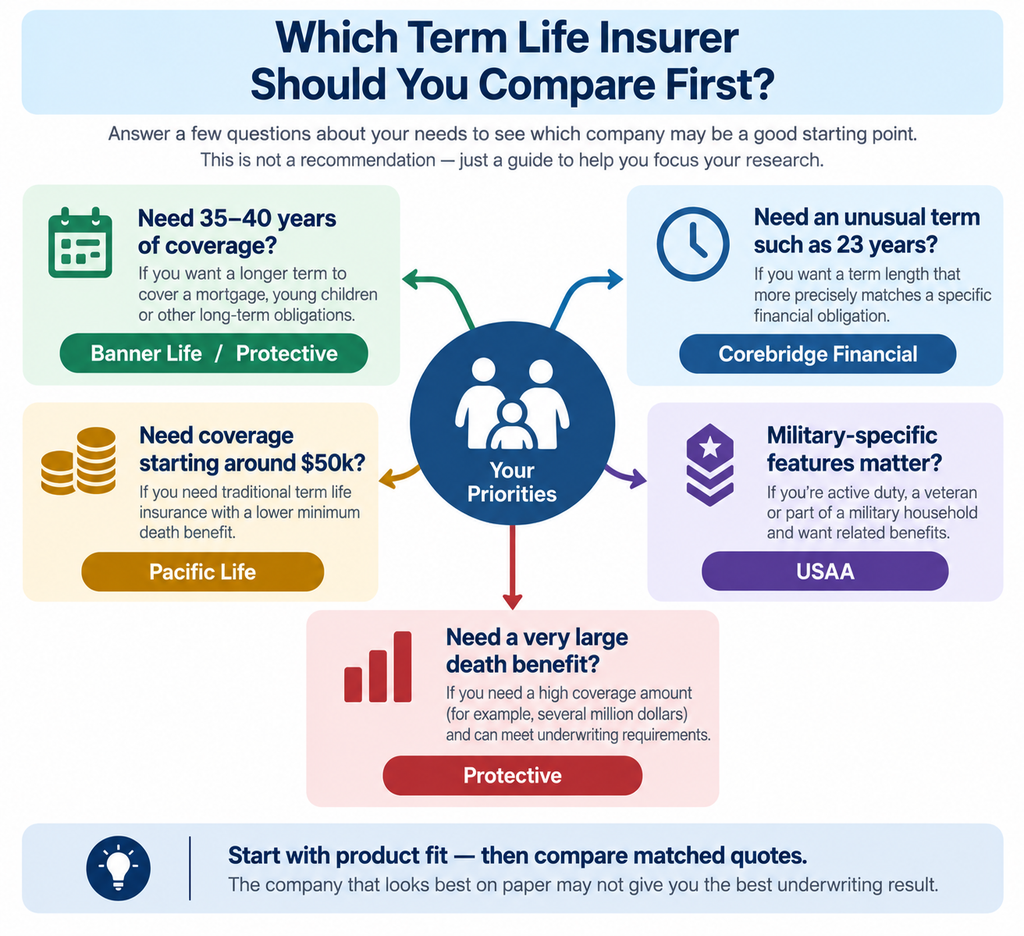
Which Term Life Company Should You Investigate First?
There is no universal order, but these product differences can narrow the search.
Investigate Banner Life if you value 35- or 40-year terms, broad standard-term choices or its current accelerated-underwriting pathway.
Investigate Protective if you need a very large death benefit, want up to 40 years of level-term options or place significant value on conversion flexibility.
Investigate Pacific Life if a $50,000 starting face amount is useful, you are an older applicant seeking an eligible shorter term, or PAL+ underwriting appeals to you.
Investigate Corebridge Financial if matching an unusual financial obligation to an exact number of years is particularly important.
Investigate USAA if military-specific features matter to you or Eagle Express’s $100,000–$10 million streamlined product fits your needs.
And investigate insurers outside this list too.
A shortlist should reduce your search — not prevent you from considering another company that offers a better underwriting result or contract for your circumstances.
Frequently Asked Questions
What is the best term life insurance company in 2026? There is no universal best company. Banner, Protective, Pacific Life, Corebridge and USAA each have current term products that stand out for different reasons. Your age, health, term, coverage amount and underwriting result determine which is most relevant.
Which company offers the longest term life insurance? Banner Life OPTerm and Protective Classic Choice currently offer eligible terms up to 40 years. Maximum issue ages and availability vary for longer terms.
Which company offers the most term life insurance coverage? Protective currently advertises Classic Choice coverage from $100,000 to $50 million, subject to underwriting and financial justification. A high product maximum does not mean every applicant can or should purchase that amount.
Which term insurer has the lowest minimum coverage amount? Among the products in this shortlist, Pacific Life’s PL Promise Term currently starts at $50,000.
Which company is best for a 25-year term? Several companies in this comparison offer 25-year coverage, including Banner, Protective and Pacific Life. Corebridge goes further by offering most individual durations from 15 through 30 years. Compare actual premiums and terms rather than choosing based only on duration.
Can I get term life insurance without a medical exam? Potentially. Banner, Pacific Life, USAA and Corebridge all currently describe underwriting pathways in which certain applicants may avoid a traditional exam. Eligibility is not guaranteed.
Is no-exam term life insurance more expensive? Not necessarily. Accelerated underwriting can simply be another way an insurer evaluates an otherwise traditionally underwritten applicant. Simplified-issue and guaranteed-issue products use different underwriting structures, so compare the actual policy rather than assuming all no-exam coverage costs more.
Should I choose the cheapest term life company? Price is important, but compare equivalent coverage and final underwriting offers. Conversion options, term length, riders and insurer strength can also matter.
How many life insurance companies should I compare? There is no required number, but comparing several carriers can be valuable because insurers do not always evaluate health and lifestyle factors identically.
Is 20 or 30 years better for term life insurance? Neither is universally better. Choose a term around the period your financial need is expected to remain. A young family with a newborn may need a different duration than someone with 12 years remaining on a mortgage.
What happens if I outlive my term policy? The level-premium period ends. Depending on the contract, you may be able to let coverage end, continue it at higher renewal premiums, convert eligible coverage to permanent insurance or apply for a new policy.
Should I replace an existing term policy with a cheaper one? Only after comparing the full policies and obtaining final approval for the replacement. Age, new underwriting, conversion rights and restarting policy-specific periods can affect the decision.


