

Introduction
MassMutual and Guardian are two of the best-known mutual life insurance companies in the United States, and they are especially relevant for people comparing participating whole life insurance.
Both companies offer permanent coverage with guaranteed elements, cash value and the potential to receive policy dividends. Both also carry very strong financial-strength ratings.
That makes this comparison less about finding an obvious winner and more about understanding how the actual policy illustrations, guarantees, dividend assumptions and riders differ.
Quick answer: MassMutual currently has the higher 2026 Dividend Interest Rate and announced a larger total policyowner dividend payout, while Guardian currently holds a stronger Moody’s financial-strength rating and offers some distinctive whole-life features. Neither fact alone makes one company better. If you are comparing participating whole life, the most useful approach is to request equivalent illustrations and compare guaranteed values, premiums and non-guaranteed assumptions side by side.
MassMutual vs. Guardian at a Glance
| Feature | MassMutual | Guardian |
|---|---|---|
| Company structure | Mutual insurer | Mutual insurer |
| Founded | 1851 | 1860 |
| A.M. Best | A++ (Superior) | A++ (Superior) |
| Moody’s | Aa3 (High Quality) | Aa1 (High Quality) |
| S&P | AA+ (Very Strong) | AA+ (Very Strong) |
| 2026 Dividend Interest Rate | 6.60% | 6.25% |
| 2026 announced dividend allocation | Approximately $2.9 billion | Approximately $1.7 billion |
| Participating whole life | Yes | Yes |
| Guaranteed cash value | Yes, according to policy guarantees | Yes, according to policy guarantees |
| Dividends guaranteed? | No | No |
Ratings can change, so they should be checked again when you apply rather than treated as permanent.
More importantly, a company’s rating and dividend announcement are only part of a whole-life comparison. The actual policy design determines what you are buying.
What Being a Mutual Insurance Company Means
MassMutual and Guardian are both mutual insurers.
Unlike a publicly traded stock insurer with outside shareholders, a mutual insurance company is owned by its eligible policyholders.
For participating whole life policies, this structure creates the possibility of receiving dividends when the company declares them.
That does not mean every policyholder receives the same dividend or that dividends are guaranteed.
The amount credited to an individual policy can depend on the policy type, its size, when it was issued and other components of the insurer’s dividend formula.
Both companies also provide guaranteed contractual elements separately from non-guaranteed dividends.
When comparing policies, it is important to keep those two categories separate.
2026 Dividend Comparison
The headline numbers currently favor MassMutual, but they need context.
| 2026 Dividend Measure | MassMutual | Guardian |
|---|---|---|
| Dividend Interest Rate | 6.60% | 6.25% |
| Announced dividend allocation | ~$2.9 billion | ~$1.7 billion |
| Consecutive dividend history | Paid eligible participating policyowners annually since 1869 | Paid eligible participating policyholders annually since 1868 |
MassMutual increased its 2026 Dividend Interest Rate to 6.60% and announced approximately $2.9 billion in dividends for eligible participating policyowners.
Guardian increased its 2026 Dividend Interest Rate to 6.25% and announced approximately $1.7 billion for participating policyholders.
Those are impressive numbers from both companies.
But there is an important warning:
The Dividend Interest Rate is not the rate of return on your whole life policy.
MassMutual specifically states that its DIR is used as part of the calculation for the investment component of the dividend and should not be treated as the policy’s rate of return.
Guardian similarly explains that its Dividend Interest Rate is not the same as an individual policyholder’s return.
That means choosing MassMutual simply because 6.60% is higher than 6.25% would be an incomplete comparison.
How Whole Life Dividends Actually Add Value
Participating whole life policies contain guaranteed values established by the contract.
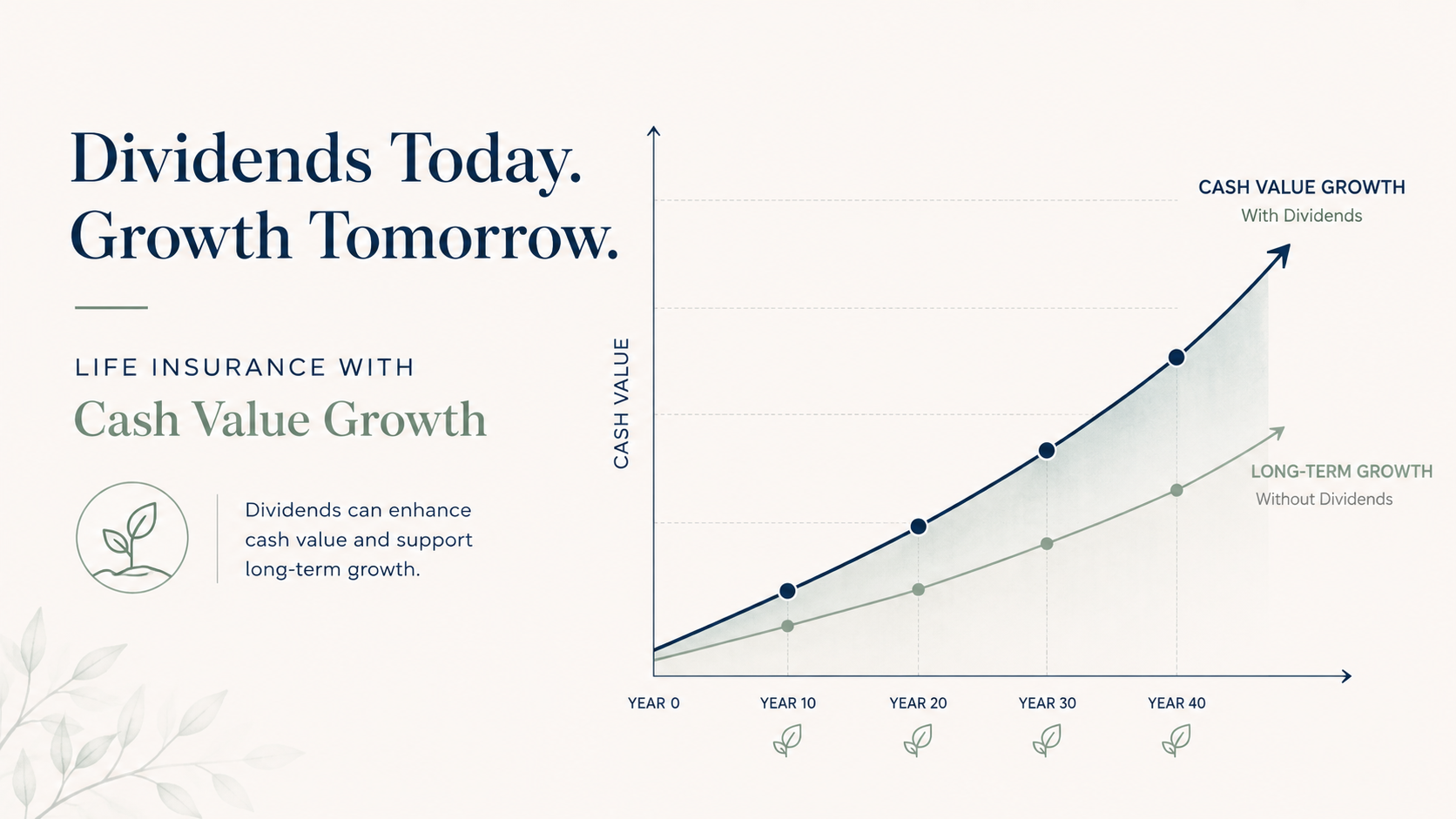
Dividends can add non-guaranteed value on top of those guarantees.
Depending on the policy and insurer, dividends may be used in ways such as:
- Purchasing paid-up additional insurance
- Reducing future premiums
- Receiving cash
- Accumulating value according to the available dividend option
- Applying value toward certain policy obligations
One common option is purchasing paid-up additions, often called PUAs.
A paid-up addition is additional permanent life insurance purchased without requiring future premiums for that specific addition. It can increase both death benefit and cash value.
Over time, dividends used to purchase PUAs can themselves participate in future dividends, although those future dividends remain non-guaranteed.
Both MassMutual and Guardian offer ways for eligible participating policyholders to use dividends to increase policy value.
The exact available options should be confirmed in the policy illustration and contract.
Guaranteed Values vs. Illustrated Values
This is one of the most important concepts when comparing whole life insurance.
A whole-life illustration typically contains both:
Guaranteed values — amounts the insurer contractually guarantees if required premiums are paid and other policy conditions are met.
Non-guaranteed values — projections that can depend partly on future dividends or other assumptions.
Do not compare two policies by looking only at the largest projected cash-value number decades into the future.
Instead, compare:
- Guaranteed death benefit
- Guaranteed cash value
- Required premium
- Premium-payment period
- Guaranteed values at selected ages
- Current illustrated values
- Dividend assumptions
- Paid-up additions
- Loans and loan interest
- Available riders
Then ask what happens if future dividends are lower than illustrated.
A strong whole-life policy should still make sense based on the guarantees and your actual need for permanent coverage — not only on an optimistic projection.
Financial Strength: Both Are Extremely Strong
Life insurance can remain in force for decades, so the financial strength of the insurer matters.
MassMutual currently reports:
- A++ (Superior) — A.M. Best
- AA+ (Very Strong) — Fitch
- Aa3 (High Quality) — Moody’s
- AA+ (Very Strong) — S&P
Guardian currently reports:
- A++ (Superior) — A.M. Best
- Aa1 (High Quality) — Moody’s
- AA+ (Very Strong) — S&P
Guardian also currently reports a Comdex score of 100.
These ratings indicate that both companies are considered financially strong by major rating agencies.
But rating scales differ between agencies, so you should not compare an Aa1 from Moody’s directly with an A++ from A.M. Best as though they were part of the same scale.
The more useful conclusion is that both insurers currently carry very strong ratings, while Guardian holds the higher current Moody’s rating.
Where MassMutual May Stand Out
MassMutual deserves particular attention if its participating whole-life illustration fits your goals and you value its current dividend record.
Its 2026 announcement includes:
- A 6.60% Dividend Interest Rate
- Approximately $2.9 billion in expected policyowner dividends
- 158 consecutive years of annual dividends to eligible participating policyowners
MassMutual whole life also provides guaranteed cash-value growth and the opportunity to use dividends to purchase additional insurance or help address premiums, among other available options.
The company currently reports nearly $1.1 trillion of life insurance protection in force and very strong financial-strength ratings.
None of those points proves that a MassMutual policy will outperform a Guardian policy for you.
They are reasons to request an illustration and include MassMutual in a serious comparison.
Where Guardian May Stand Out
Guardian offers a similarly strong participating whole-life platform but includes some distinctive policy features.
Its 2026 dividend announcement includes:
- A 6.25% Dividend Interest Rate
- Approximately $1.7 billion allocated to participating policyholders
- A dividend history extending annually back to 1868
Guardian also currently holds an Aa1 Moody’s rating, compared with MassMutual’s Aa3.
One distinctive feature available with select Guardian participating whole-life policies is the Index Participation Feature, or IPF.
This feature can allow eligible policyholders to allocate a portion of the cash value associated with paid-up additions so that an adjustment to the dividend is linked to movement in the S&P 500 Price Return Index, subject to contractual limits, costs, caps and floors.
This does not mean the whole-life cash value is invested directly in the S&P 500.
Guardian states that negative index performance can reduce the dividend adjustment relative to what otherwise might have been credited.
The IPF therefore adds another feature to evaluate, not an automatic reason to choose Guardian.
Which Company Has Better Cash Value?
There is no responsible universal answer.
Cash-value results depend on the actual policy design.
Two policies from the same insurer can produce different results when structured with:
- Different base premiums
- Different paid-up additions
- Different riders
- Different payment periods
- Different death benefits
- Different dividend options
That is why comparing a generic “MassMutual cash value” against a generic “Guardian cash value” is not very useful.
Instead, request illustrations designed around the same goal and approximately equivalent premium commitment.
Then compare the values at specific points, such as:
- Year 5
- Year 10
- Year 20
- Age 65
- Age 80
And compare both the guaranteed and current illustrated columns.
Which Company Is Cheaper?
Whole-life pricing should not be reduced to a universal “MassMutual is cheaper” or “Guardian is cheaper.”
The premium depends on factors including:
- Age
- Health
- Tobacco or nicotine use
- Coverage amount
- Policy design
- Premium-payment period
- Riders
- Underwriting classification
- State
For whole life, the cheapest premium may not even be the primary objective.
Two policies can have similar death benefits but very different designs for cash value, paid-up additions or premium duration.
The comparison should therefore focus on what the premium buys, not simply which number is lower.
How to Compare Two Whole-Life Illustrations
If you are seriously considering both companies, request illustrations using as close to the same assumptions as possible.
Then complete this table:
| Question | MassMutual | Guardian |
|---|---|---|
| Initial death benefit | $________ | $________ |
| Annual premium | $________ | $________ |
| Premium payment period | ________ | ________ |
| Guaranteed cash value at year 10 | $________ | $________ |
| Current illustrated cash value at year 10 | $________ | $________ |
| Guaranteed cash value at year 20 | $________ | $________ |
| Current illustrated cash value at year 20 | $________ | $________ |
| Dividend option | ________ | ________ |
| Paid-up additions included? | Yes / No | Yes / No |
| Loan provisions | ________ | ________ |
| Important riders | ________ | ________ |
Do not allow one illustration to use an aggressive paid-up-additions design while the other uses a basic whole-life structure and then treat them as directly comparable.
The policy designs should be as similar as reasonably possible.
Important: A Dividend Interest Rate is not the rate of return on a whole-life policy. Dividends are not guaranteed, and policy results depend on the actual contract and policy design.
Which Company Would I Investigate First?
MassMutual may deserve a closer look if its guaranteed and illustrated values fit your goals, you value its current dividend history and 2026 dividend announcement, or its policy design works particularly well for your desired premium structure.
Guardian may deserve a closer look if its illustration provides a better fit, its current stronger Moody’s rating matters to you, or features such as its available whole-life riders or Index Participation Feature are relevant to your goals.
Compare both if you are seriously considering participating whole life.
When two companies are this financially strong, the actual policy design can be more important than choosing a winner based on the company name.
Frequently Asked Questions
Which has the higher 2026 Dividend Interest Rate, MassMutual or Guardian? MassMutual currently has the higher announced 2026 DIR at 6.60%, compared with Guardian’s 6.25%. However, the DIR is not the policy’s rate of return and should not be used by itself to decide which policy is better.
Which company is financially stronger? Both currently have very strong ratings. Each holds A++ from A.M. Best and AA+ from S&P. Guardian currently holds Aa1 from Moody’s, while MassMutual holds Aa3. Ratings can change and should be checked again when purchasing coverage.
Are whole-life dividends guaranteed? No. Both companies clearly state that dividends are not guaranteed, even though each has a long history of paying dividends to eligible participating policyholders.
Does a higher Dividend Interest Rate mean higher cash value? Not necessarily. The DIR is only one component involved in determining dividends. Actual policy results depend on policy design, guarantees, dividend calculations and how paid dividends are used.
Can dividends be used to buy more life insurance? Yes. Both companies offer dividend options that can include purchasing paid-up additional insurance, which can increase cash value and death benefit.
Is MassMutual cheaper than Guardian? There is no universal answer. Premiums and policy values depend on underwriting and policy design. Compare equivalent illustrations rather than assuming one mutual insurer is always cheaper.
Is Guardian’s Index Participation Feature the same as investing in the S&P 500? No. Guardian states that the feature adjusts part of the dividend calculation based on movement in the S&P 500 Price Return Index, subject to limits and costs. The policyowner is not directly investing the whole-life cash value in the index.
Which company is better for whole life insurance? Neither is universally better. Compare guaranteed values, premiums, policy design, non-guaranteed illustrations, dividend options and riders using equivalent assumptions before choosing.


