


Introduction
Term life and whole life insurance can both provide a death benefit, but they are designed to solve different types of financial problems.
Term life provides coverage for a defined period.
Whole life is permanent insurance designed to remain in force for life when required premiums are paid and policy conditions are satisfied.
Whole life also builds cash value, while standard term insurance generally does not.
That does not make one product universally better.
A parent who needs $1 million of income-replacement protection for the next 20 years has a very different insurance need from someone who wants a guaranteed death benefit intended to remain for life.
Quick answer: Term life is usually the first type to compare when you need a large death benefit for a temporary period and want to keep the initial premium lower. Whole life may deserve consideration when you have a genuine lifelong insurance need, value contractual cash-value guarantees and can comfortably maintain the higher premium. Some people may appropriately use a combination of both.
Term Life vs. Whole Life at a Glance
| Feature | Term Life Insurance | Whole Life Insurance |
|---|---|---|
| Coverage duration | Defined term | Designed for life |
| Death benefit | Payable if covered death occurs while policy is in force | Designed to remain available for life while policy requirements are met |
| Initial premium | Generally lower for comparable death benefit | Generally higher |
| Cash value | Generally none | Yes |
| Premium structure | Often level for selected term, then may increase if renewed | Typically level according to contract |
| Guaranteed cash-value growth | No cash value | Yes, according to policy guarantees |
| Potential dividends | Generally no | Some participating policies may pay non-guaranteed dividends |
| Best suited to | Temporary financial needs | Lifelong financial needs |
| Medical underwriting | Depends on product | Depends on product |
| Can lapse? | Yes, if required premiums are not paid | Yes, depending on premium/payment and policy status |
| Complexity | Usually simpler | More features to evaluate |
The most important distinction is not simply price.
It is:
How long does the financial need exist?
What Is Term Life Insurance?
Term life insurance provides death-benefit protection for a defined period.
Common level-term durations include:
- 10 years
- 15 years
- 20 years
- 25 years
- 30 years
- Longer periods from certain insurers
With level term, the scheduled premium generally remains level during the selected initial period.
If the insured dies while the policy is in force during that period, the insurer pays the applicable death benefit to the beneficiaries according to the contract.
If the insured survives the term, the initial level period ends.
Depending on the policy, possible options may include:
- Letting coverage end
- Renewing at higher premiums
- Converting eligible coverage to permanent insurance
- Applying for a new policy
Term life generally does not accumulate cash value.
Its primary purpose is death-benefit protection.
When Term Life Often Makes Sense
Term insurance can be particularly useful when the financial need has a foreseeable end date.
Examples include:
Income replacement
A family may need protection while the insured is still working.
Children
Parents may want coverage until children are financially independent.
Mortgage
A household may want protection during the remaining mortgage period.
Education
Coverage can help protect plans for children who still have many years before college.
Temporary debt
Certain business or personal obligations may exist for only a defined number of years.
The policy term should ideally align with the period during which your death would create the largest financial problem.
Our 10-Year vs. 20-Year vs. 30-Year Term Life Insurance guide explains how to choose that duration.
What Is Whole Life Insurance?
Whole life is a form of permanent life insurance.
Unlike term coverage, it is designed to remain in force for the insured’s lifetime when required premiums are paid and the policy remains in good standing.
Traditional whole life generally includes:
- A death benefit
- Level premium structure
- Guaranteed cash-value accumulation
- Contractual guarantees
- Potential access to accumulated cash value
Some whole-life policies are also participating policies.
That means they may be eligible for dividends.
However:
Dividends are not guaranteed.
The guaranteed values and non-guaranteed values should always be evaluated separately.
Whole Life Cash Value
Part of what differentiates whole life from term is its cash-value component.
Cash value generally builds gradually according to the guarantees in the contract.
Depending on the policy, the owner may eventually be able to access value through methods such as:
- Withdrawals
- Policy loans
- Surrendering the policy
These options are not free money.
Accessing cash value can affect:
- Remaining cash surrender value
- Death benefit
- Policy performance
- Tax treatment in some circumstances
Policy loans also accrue interest.
An outstanding loan can reduce the death benefit if it remains unpaid.
The important point is that whole life combines insurance protection with a contractual cash-value component.
Term life generally does not.
Whole Life Is Not the Same as an Investment Account
Whole life is sometimes marketed or discussed primarily in investment language.
That can make comparisons confusing.
A whole-life policy is first:
a life insurance contract.
Its cash value and guarantees can have financial-planning uses, but it should not automatically be compared with:
- An S&P 500 index fund
- A 401(k)
- An IRA
- A brokerage account
- A savings account
These products have different purposes, risks, liquidity characteristics, tax rules and guarantees.
Likewise, saying:
“Investing the difference always beats whole life.”
is too broad.
Investment returns are not guaranteed, and whole life is solving an insurance need as well as providing contractual values.
The more useful question is:
Do I need permanent insurance, and are the guarantees and cash-value features worth the premium commitment for my situation?
Why Term Life Usually Costs Less Initially
With term insurance, the insurer is providing coverage only for the specified period.
Whole life is designed to provide permanent protection and builds cash value.
Those additional guarantees and features generally make whole-life premiums substantially higher than term premiums for the same initial death benefit.
For example, comparing:
$500,000 term life
with:
$500,000 whole life
for the same applicant would typically show a much higher premium for whole life.
But that does not prove term is universally superior.
The two policies are promising different things.
The appropriate comparison must include:
- Coverage duration
- Death benefit
- Premium
- Cash value
- Guarantees
- Financial objective
Term Life Is Not “Throwing Money Away”
A common criticism of term life is:
“If you outlive the policy, you get nothing back.”
For ordinary level term, there is usually no cash-value refund when the policy ends.
But that does not mean the premiums were wasted.
You paid for insurance protection during the years the policy was active.
That is similar to many other forms of insurance.
If you needed $1 million of income-replacement protection while raising children and the children later became financially independent, the insurance may have successfully served its purpose even though no death claim occurred.
The objective of insurance is risk transfer.
It is not necessarily to generate a financial return.
Whole Life Is Not Automatically Better Because It Lasts Forever
The opposite mistake is assuming permanent coverage is automatically superior because it cannot expire at the end of a fixed term.
Lifetime protection only creates value if you actually need lifetime protection and can maintain the policy.
Suppose a 30-year-old needs:
$1 million for the next 25 years
to protect children and replace income.
If the household cannot comfortably afford $1 million of whole-life coverage, buying a much smaller permanent policy simply because it lasts forever could leave the family significantly underinsured during the years when the financial risk is greatest.
Coverage amount matters.
Duration matters.
Budget matters.
Permanent duration alone does not solve inadequate protection.
Temporary Need vs. Lifelong Need
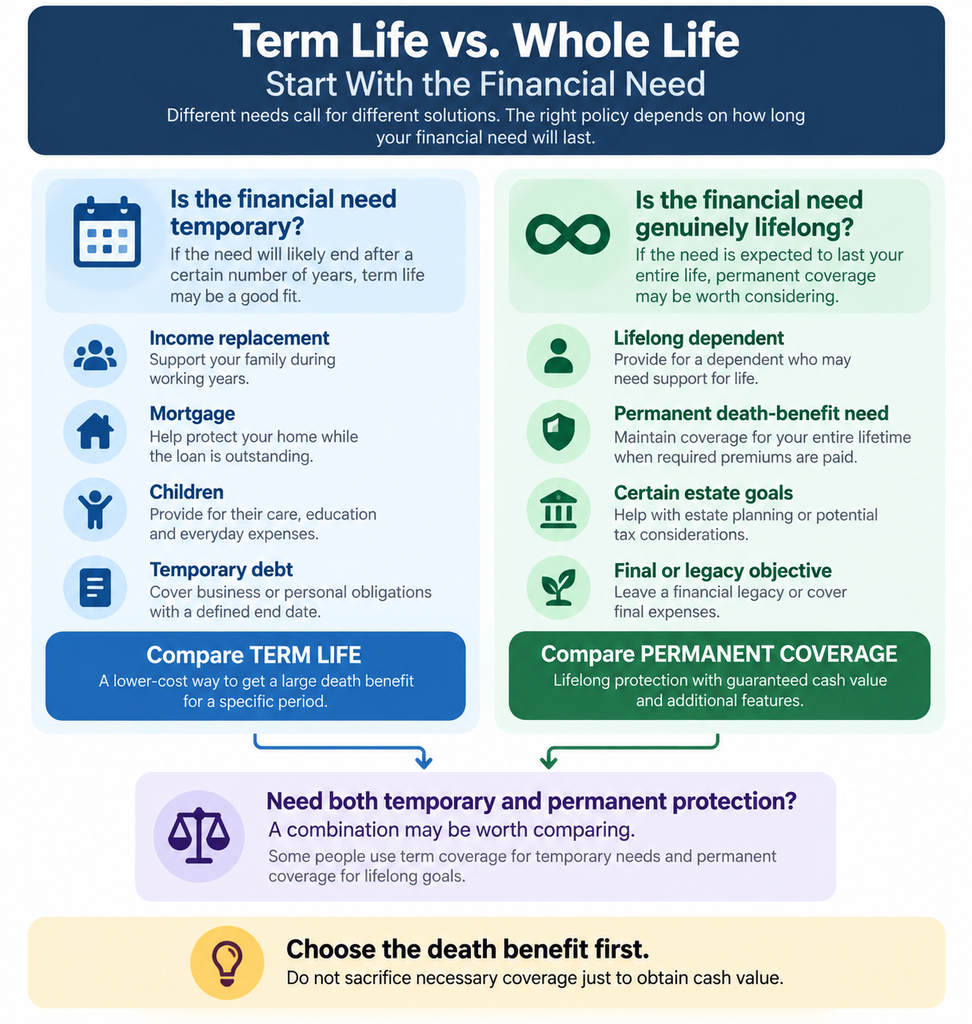
A useful way to approach the decision is to separate financial obligations into two categories.
Temporary needs
Examples can include:
- Income replacement until retirement
- Mortgage
- Childcare
- Education funding
- Temporary debt
- Business loans
Term insurance can often match these needs efficiently.
Lifelong needs
Examples can include:
- Support for a dependent who may need assistance for life
- Certain estate-planning objectives
- Final expenses when permanent funding is desired
- Specific legacy goals
- Certain business or succession-planning needs
Permanent insurance may deserve consideration for these objectives.
Not every lifelong goal necessarily requires whole life, because other types of permanent insurance also exist.
But this distinction provides a much better starting point than simply asking which policy type is “better.”
How Much Coverage Do You Need?
Policy type should not determine your death benefit.
Calculate the financial need first.
Consider:
- Income replacement
- Mortgage or housing
- Debt
- Children
- Education
- Support for dependents
- Final expenses
- Business obligations
- Other financial goals
Then subtract available resources such as:
- Savings
- Existing life insurance
- Employer coverage
- Other assets intended for survivors
Suppose a family calculates a current protection gap of:
$1 million
The next question is not:
“How much whole life can we afford?”
It is:
“How can we appropriately protect this $1 million need?”
If most of that need will disappear in 20–25 years, term insurance may be particularly relevant.
Our guide to how much life insurance you actually need provides a detailed coverage worksheet.
A Combination of Term and Whole Life Can Sometimes Make Sense
The decision does not always need to be:
100% term
or:
100% whole life.
Imagine a household with:
Temporary need: $800,000 for 20 years
and:
Permanent need: $100,000
One possible structure to investigate could be:
$800,000 term life
plus:
$100,000 permanent coverage
This is sometimes described as blending coverage.
It allows different policy types to address different financial needs.
That does not mean every household needs both.
The important point is that insurance can be structured around multiple time horizons.
Whole Life Guarantees vs. Non-Guaranteed Values
This is one of the most important sections to understand before buying whole life.
A whole-life illustration can contain:
Guaranteed values
and:
Non-guaranteed values.
Guaranteed elements are backed by the policy contract and the insurer’s claims-paying ability.
Non-guaranteed values may depend on future dividends or other assumptions.
For a participating whole-life policy, dividends can potentially be used to:
- Receive cash
- Reduce or help pay premiums
- Purchase paid-up additional insurance
- Accumulate according to available policy options
But dividends are not guaranteed.
Northwestern Mutual, for example, explicitly states that its whole-life dividends are not guaranteed even though it has a long history of paying them.
Never evaluate a whole-life policy using only the most optimistic illustrated column.
How to Read a Whole Life Illustration
When comparing policies, ask to see values at consistent years.
For example:
| Value | Year 5 | Year 10 | Year 20 | Age 65 |
|---|---|---|---|---|
| Premium paid | $_____ | $_____ | $_____ | $_____ |
| Guaranteed cash value | $_____ | $_____ | $_____ | $_____ |
| Current illustrated cash value | $_____ | $_____ | $_____ | $_____ |
| Guaranteed death benefit | $_____ | $_____ | $_____ | $_____ |
| Current illustrated death benefit | $_____ | $_____ | $_____ | $_____ |
Then ask:
Which values are contractually guaranteed?
Which depend on dividends?
What assumptions create the illustrated values?
What happens if future dividends are lower?
How long are premiums required?
This produces a more meaningful comparison than looking at one projected cash-value number decades into the future.
Policy Loans Need to Be Understood
Whole-life owners may be able to borrow against available policy value.
That flexibility can be useful.
But a policy loan is still a loan.
It generally:
- Accrues interest
- Reduces available policy value
- Can reduce the death benefit if unpaid
- Can affect policy performance
- Can create additional consequences if a heavily loaned policy lapses
Do not interpret:
“You can borrow your own money tax-free.”
as a complete explanation of policy loans.
Tax treatment depends on how the policy is structured and what happens to it later.
Ask for a policy-specific explanation before using loans as a long-term strategy.
Life Insurance Tax Treatment Needs Nuance
Life insurance can have valuable federal tax treatment.
Death benefits paid because of the insured’s death are generally excluded from the beneficiary’s federal gross income, although exceptions exist.
Cash value within a qualifying life insurance policy can generally grow on a tax-deferred basis.
But that does not mean:
“Everything you do with whole life is tax-free.”
For example, surrendering a policy for more than your cost basis can create taxable income. The IRS specifically addresses this treatment.
Modified Endowment Contracts, policy loans, withdrawals, lapses and other transactions can also create more complicated tax consequences.
For significant cash-value strategies, consult a qualified tax professional rather than relying solely on a sales illustration.
What Is a Modified Endowment Contract?
A Modified Endowment Contract, or MEC, is a life insurance policy that fails specific federal funding tests.
A policy can still remain life insurance, but the tax treatment of distributions changes.
The IRS uses a 7-pay test as part of determining MEC status.
For a MEC, distributions and loans can receive less favorable tax treatment than they would under a non-MEC life insurance policy.
You do not need to become a tax-law expert before buying whole life.
But if a policy is being designed with unusually high early premiums specifically to maximize cash value, ask:
Could this policy become a MEC?
and:
How would that change access to the cash value?
What About Return of Premium Term?
Return of premium term sits between ordinary term and the desire to recover some premiums if the insured survives the term.
Under an ROP contract, eligible premiums may be returned after the selected period if policy requirements are satisfied.
But ROP generally costs more than comparable ordinary term.
It does not provide the same structure as whole-life cash value.
If the reason you are considering whole life is simply:
“I hate paying term premiums and getting nothing back.”
compare ordinary term, ROP term and permanent coverage as three different structures.
Our Return of Premium Term Life Insurance guide explains this comparison.
What About Converting Term to Whole Life Later?
Some term policies include a conversion privilege.
This can allow eligible coverage to be converted to a permanent product without completing new medical underwriting, subject to:
- Conversion deadline
- Available products
- Age limits
- Policy rules
This can be valuable if your health deteriorates.
New York Life, for example, currently describes term conversion to eligible permanent coverage without a new medical exam, subject to conversion rules and timing.
Conversion does not preserve the term premium.
Permanent coverage will have a different cost structure.
Our guide to converting term life insurance near retirement explains when this feature may matter.
Term Life vs. Whole Life Decision Worksheet
Start with the insurance need.
Total death benefit currently needed: $________
How much of that need is temporary? $________
How many years will the temporary need last? ______ years
How much of the need is genuinely lifelong? $________
Current savings/assets available to survivors: $________
Existing life insurance: $________
Now compare:
| Question | Term Life | Whole Life |
|---|---|---|
| Death benefit being compared | $________ | $________ |
| Premium | $________ | $________ |
| Coverage duration | ______ years | Lifetime if maintained |
| Premium guaranteed for | ______ | ______ |
| Guaranteed cash value | None | $________ |
| Non-guaranteed values | N/A | $________ |
| Conversion available? | Yes / No | N/A |
| Dividend eligibility? | Usually no | Yes / No |
| Premium comfortably affordable long term? | Yes / No | Yes / No |
| Matches temporary need? | Yes / No | Yes / No |
| Matches permanent need? | Yes / No | Yes / No |
Then ask:
- What financial problem does this policy solve?
- How long does that problem exist?
- Am I sacrificing necessary death benefit just to obtain cash value?
- Can I comfortably maintain the premium for the required period?
- Which illustration values are guaranteed?
- Would a combination of term and permanent insurance fit better?
- Have I compared multiple insurers and equivalent policy designs?
Do not start with the product.
Start with the financial need.
When Term Life May Be the Better Fit
Term life deserves strong consideration when:
- You need a relatively large death benefit.
- The financial need is temporary.
- Budget is important.
- Children are the main reason for coverage.
- A mortgage has a defined remaining period.
- Income replacement is needed only until retirement.
- You primarily want straightforward death-benefit protection.
For many young families, this can make term insurance an efficient way to obtain substantial protection during the years of greatest financial vulnerability.
When Whole Life May Be the Better Fit
Whole life may deserve consideration when:
- A genuine insurance need is expected to last for life.
- You want contractual cash-value guarantees.
- You value stable premiums.
- You can comfortably fund the policy over the required period.
- A lifelong dependent requires financial support.
- Permanent estate or legacy objectives exist.
- You understand the guaranteed and non-guaranteed portions of the illustration.
The fact that whole life has cash value is not enough by itself.
The permanent insurance need and premium commitment still need to make sense.
When Neither Should Be Purchased Yet
Sometimes the best decision is to gather more information before buying either.
You may need to do more work if:
- You do not know how much coverage is needed.
- You have not identified how long the financial need lasts.
- The proposed premium strains the household budget.
- You do not understand the policy illustration.
- You are being asked to replace an existing policy without understanding the consequences.
- You have not compared alternatives.
The correct life insurance policy is not necessarily the most sophisticated one.
It is the one that appropriately covers the financial risk and can realistically remain in force.
Common Term vs. Whole Life Mistakes
Assuming term is always better because it is cheaper. It may not address a genuine lifelong need.
Assuming whole life is always better because it lasts forever. Permanent duration does not compensate for inadequate coverage.
Buying less death benefit just to afford whole life. Protect the financial need first.
Treating whole life as a guaranteed high-return investment. It is a life insurance contract with guarantees, cash value and potentially non-guaranteed dividends.
Assuming investing the difference always produces a specific better result. Investment returns, investor behavior and future conditions are uncertain.
Ignoring guaranteed vs. illustrated values. Whole-life illustrations can contain both.
Treating dividends as guaranteed. Participating-policy dividends are not guaranteed.
Ignoring policy-loan interest. Loans can reduce policy value and death benefit and may create complications.
Assuming all cash-value access is tax-free. Tax treatment depends on the transaction and policy status.
Using a universal salary multiple to choose the death benefit. Calculate the actual household financial gap instead.
Choosing a policy type before identifying the duration of the need. Temporary and lifelong obligations should be separated first.
Frequently Asked Questions
Is term life or whole life better? Neither is universally better. Term is often appropriate for large temporary needs, while whole life can be appropriate for genuine lifelong needs and buyers who value contractual cash-value guarantees.
Why is term life cheaper than whole life? Term generally covers a defined period and does not build cash value. Whole life is designed to remain in force for life and includes guaranteed cash-value accumulation, resulting in a different cost structure.
What happens if I outlive term life insurance? The initial term ends. Depending on the contract, you may let coverage expire, renew at a higher premium, convert eligible coverage or apply for a new policy.
Do you get your term life premiums back? Standard term generally does not refund premiums when the insured survives the term. Return-of-premium term is a separate product designed differently.
Does whole life insurance expire? Whole life is designed to provide lifetime coverage when required premiums are paid and the policy remains in force.
Does whole life build cash value? Yes. Whole-life policies generally provide guaranteed cash-value accumulation according to the policy contract.
Are whole-life dividends guaranteed? No. Participating policies may receive dividends, but dividends are not guaranteed.
Can I lose money on whole life insurance? The answer depends on what is meant by “lose money.” Early cash surrender value can be lower than premiums paid, and surrendering or modifying a policy can produce different outcomes. Review both guaranteed and non-guaranteed values before purchasing.
Is whole life insurance an investment? Whole life is primarily life insurance. It includes a cash-value component with financial characteristics, but it should not automatically be treated as a substitute for traditional investment accounts.
Is term life insurance a waste of money if I do not die during the term? No. The premiums purchased death-benefit protection during the insured period. The policy can successfully serve its purpose even if no claim occurs.
Can I have both term and whole life insurance? Yes. Some households use term for large temporary obligations and permanent coverage for smaller lifelong needs.
Can term life be converted to whole life? Some term policies offer conversion to eligible permanent coverage without new medical underwriting during a specified conversion period. The rules depend on the insurer and contract.
Is whole life cash value tax-free? That description is too broad. Cash value can generally grow tax deferred, but withdrawals, surrender, loans, MEC status and policy lapse can create different tax consequences.
How much life insurance should I buy? Calculate the actual financial gap using income replacement, debts, housing, dependents and other obligations, then subtract existing assets and coverage. Do not rely solely on a universal multiple of salary.


