
Introduction
Buying life insurance is one of those decisions people research for weeks and still get wrong in small, expensive ways. Most mistakes aren’t about picking the “wrong” company — they’re about structural choices made early in the process that quietly cost thousands of dollars over the life of a policy, or leave a family under-protected exactly when they needed the coverage most. Here are the mistakes that come up again and again, and how to avoid each one.
Quick answer: The most expensive mistakes are waiting too long to buy, underestimating how much coverage you need, choosing a term length that doesn’t match your actual financial timeline, and not disclosing health information accurately on the application.
Mistake #1: Waiting Too Long to Apply
As we covered in our article on how age affects your rates, premiums rise roughly 8-10% for every year you wait — permanently, for the life of the policy. People often wait for a “better time” (after a raise, after a health goal, after a big life event), but the insurer is pricing based on your age and health today, not your future plans. If you know you’ll need coverage, the cheapest day to buy it is usually today.
Mistake #2: Underestimating How Much Coverage You Need
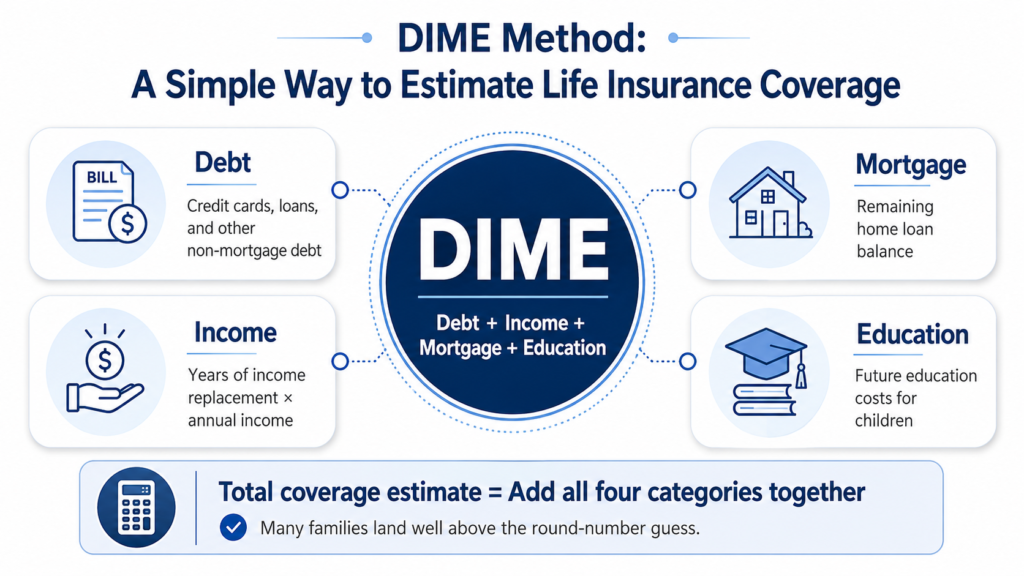
Financial planners generally recommend coverage of 10-15 times your annual income as a starting benchmark, according to the Insurance Information Institute. A common shortcut is picking a round number that feels “big enough” — $250,000, $500,000 — without actually calculating it. A more reliable approach is the DIME method:
- Debt: total non-mortgage debt (credit cards, loans)
- Income: years of income you want to replace × your annual income
- Mortgage: remaining balance on your home
- Education: future education costs for your children
Add those together, and you’ll typically land on a bigger number than most people initially guess — often $750,000 to $1.5 million for someone with a mortgage and young kids, not the $250,000 many default to.
Mistake #3: Choosing the Wrong Term Length
A 20-year term policy bought at 30 expires at 50 — potentially years before your mortgage is paid off or your kids finish college. Match your term length to your actual financial timeline, not a default option:
- Mortgage protection: term length ≈ years remaining on your mortgage
- Income replacement while raising kids: term length ≈ years until your youngest child is financially independent
- General family protection: many people layer two policies (e.g. a 30-year term for the mortgage + a shorter 15-year term for the high-expense child-rearing years) instead of buying one large policy
Mistake #4: Being Inaccurate on the Health Questionnaire
This one isn’t just a pricing mistake — it can void your policy entirely. Insurers can investigate a claim during the “contestability period” (typically the first two years) and deny payment if they find a material misrepresentation, like undisclosed smoking or a hidden health condition. If you’re a former smoker, disclose it — most insurers have a “non-smoker” rate available after 12+ months without nicotine, so there’s rarely a reason to hide it.
Mistake #5: Not Comparing No-Exam vs. Fully Underwritten Options
Some buyers assume no-exam policies are always more expensive, and others assume the opposite — neither is universally true. It depends on your health profile. Someone in excellent health might get a lower rate through full underwriting (because the exam proves their health), while someone who wants speed and simplicity, or who’s slightly outside “perfect” health, might do just as well or better with a no-exam provider like Ethos or Ladder. The only way to know is to compare both.
Mistake #6: Letting a Policy Lapse Without a Plan
If your term ends and you still need coverage, letting it lapse and reapplying later means requalifying at your current (older) age and health status — which, as covered above, is almost always more expensive. If you’re approaching the end of a term and still need coverage, start shopping for a new policy 6-12 months before expiration, not after.
Mistake #7: Not Naming (or Updating) Beneficiaries Properly
An outdated beneficiary designation — an ex-spouse still listed, or no contingent beneficiary named at all — can send your death benefit somewhere you never intended, or into a lengthy probate process. Review your beneficiary designations any time you have a major life change: marriage, divorce, a new child, or the death of a named beneficiary.
Frequently Asked Questions
Is it a mistake to buy the cheapest policy I qualify for? Not necessarily — price matters, but coverage amount and term length matter more. A cheap policy that’s too small or expires too early doesn’t actually protect your family when they need it.
Should I buy life insurance through my employer instead of on my own? Employer group policies are a good supplement, but they usually aren’t portable if you leave your job, and coverage amounts are often capped well below what a family actually needs. Most financial advisors recommend an individual policy as your primary coverage, with employer coverage as a bonus layer.
Is it a mistake to skip a medical exam if I qualify for one at a better rate? Only if the savings outweigh the time cost. If you need coverage immediately (a new mortgage, a new baby), a slightly higher no-exam rate that gets you covered today can be the more responsible choice over waiting weeks for exam results.
This article reflects general life insurance planning principles and is not personalized financial advice. Your ideal coverage amount, term length, and policy type depend on your individual circumstances.
This article is for informational purposes only and does not constitute financial or insurance advice. termlifepicks.com is not a licensed insurance agency.